
 +86-15801534258
 info@nebulabio.cn
+86-15801534258
info@nebulabio.cn
info@nebulabio.cn
+86-15801534258
info@nebulabio.cn

The complement system is a fundamental component of innate immunity and comprises an interconnected network of soluble proteins, membrane-associated proteins, receptors, and regulatory molecules. Most circulating complement components are maintained as inactive precursors and can be rapidly activated through sequential proteolytic reactions following the recognition of pathogens, immune complexes, damaged cells, or other danger-associated signals. In addition to its well-established role in host defense, the complement system contributes to inflammatory responses, the clearance of apoptotic cells and cellular debris, the coordination of innate and adaptive immunity, and the maintenance of tissue homeostasis.
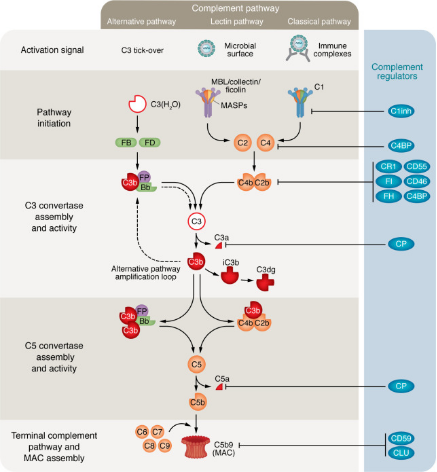
Canonical complement activation proceeds through three principal routes: the classical pathway, the lectin pathway, and the alternative pathway. The classical pathway is initiated primarily when C1q recognizes clustered IgM or IgG molecules, as well as several other target-associated ligands. This triggers activation of C1r and C1s, followed by proteolytic cleavage of C4 and C2 and assembly of the classical-pathway C3 convertase. The lectin pathway is initiated by pattern-recognition molecules, including mannose-binding lectin (MBL), ficolins, and selected collectins, which recognize characteristic glycan structures and activate MBL-associated serine proteases (MASPs). These proteases similarly cleave C4 and C2, generating the same C3 convertase, C4b2b (historically designated C4b2a), as that formed by the classical pathway. In contrast, the alternative pathway can be initiated by low-level spontaneous hydrolysis of C3, commonly referred to as “tick-over,” and subsequently involves factor B and factor D in the generation of the C3 convertase C3bBb. Importantly, the alternative pathway not only functions as an independent route of activation but also provides a powerful amplification loop that markedly increases C3b deposition initiated through any of the complement pathways.
All three activation pathways converge at the central complement component C3. C3 convertases cleave C3 into C3a and C3b. C3a functions as an anaphylatoxin that promotes inflammatory signaling and immune-cell activation, whereas C3b becomes covalently deposited on target surfaces and serves as a major opsonin, thereby facilitating recognition and phagocytic clearance of complement-coated targets. Incorporation of additional C3b into C3 convertases generates C5 convertases, which cleave C5 into C5a and C5b. C5a is a potent proinflammatory and chemoattractant mediator, whereas C5b initiates sequential recruitment of C6, C7, C8, and multiple C9 molecules, culminating in assembly of the C5b-9 membrane attack complex (MAC). MAC formation can disrupt target membranes and, under appropriate conditions, induce complement-mediated cell lysis. Thus, the major effector functions of complement activation include opsonization and phagocytic clearance, inflammatory and cellular activation, and terminal complement-mediated membrane injury.
Because the complement cascade possesses a substantial capacity for enzymatic amplification, its activity must be tightly controlled both spatially and temporally to prevent unintended injury to host tissues. Soluble regulators, including C1 inhibitor, C4b-binding protein, factor H, and factor I, together with membrane-associated regulators such as complement receptor 1 (CR1), CD46, CD55, and CD59, restrain complement activity at multiple stages of the cascade. Factor H and factor I play particularly important roles in regulating the alternative pathway and promoting C3b inactivation, whereas CD59 inhibits terminal pathway activity by preventing C9 polymerization and MAC completion. Collectively, these regulatory mechanisms allow complement to provide rapid and efficient immune protection while limiting collateral damage to host cells. Conversely, deficiencies in complement components or dysregulated complement activation can contribute to increased susceptibility to infection and to the pathogenesis of a broad spectrum of autoimmune, inflammatory, and complement-mediated disorders.
▋Related products
| Product Name | Item No |
| NebuSelect™ Native Human Complement iC3b | NBL-302003 |
| NebuSelect™ Native Human Properdin / Complement Factor P | NBL-302004 |
| NebuSelect™ Native Human Complement Factor H | NBL-302005 |
| NebuSelect™ Native Human Complement Factor D | NBL-302006 |
| NebuSelect™ Native Human Complement Factor Bb | NBL-302007 |
| NebuSelect™ Native Human Complement Factor Ba | NBL-302008 |
| NebuSelect™ Native Human Complement Factor B | NBL-302009 |
| NebuSelect™ Native Human Complement C9 | NBL-302010 |
| NebuSelect™ Native Human Complement C8 | NBL-302011 |
| NebuSelect™ Native Human Complement C7 | NBL-302012 |
| NebuSelect™ Native Human Complement C6 | NBL-302013 |
| NebuSelect™ Native Human Complement C5a | NBL-302014 |
| NebuSelect™ Native Human Complement C5 | NBL-302015 |
| NebuSelect™ Native Human Complement C4c | NBL-302016 |
| NebuSelect™ Native Human Complement C4b | NBL-302017 |
| NebuSelect™ Native Human Complement C4a | NBL-302018 |
| NebuSelect™ Native Human Complement C4 | NBL-302019 |
| NebuSelect™ Native Human Complement C3d | NBL-302020 |
| NebuSelect™ Native Human Complement C3c | NBL-302021 |
| NebuSelect™ Native Human Complement C3b | NBL-302022 |
| NebuSelect™ Native Human Complement C3a | NBL-302023 |
| NebuSelect™ Native Human Complement C3 | NBL-302024 |
| NebuSelect™ Native Human Complement C2 | NBL-302025 |
| NebuSelect™ Native Human Complement C1s Enzyme | NBL-302026 |
| NebuSelect™ Native Human Complement C1r Enzyme | NBL-302027 |
| NebuSelect™ Native Human Complement C1q | NBL-302028 |
| NebuSelect™ Native Human Complement C1 | NBL-302029 |
| NebuSelect™ Native Rat Complement Factor H | NBL-301930 |
References
Freiwald T, Afzali B. The secret life of complement: challenges and opportunities in exploring functions of the complosome in disease. J Clin Invest. 2025;135(12):e188350.