
 +86-15801534258
 info@nebulabio.cn
+86-15801534258
info@nebulabio.cn
info@nebulabio.cn
+86-15801534258
info@nebulabio.cn
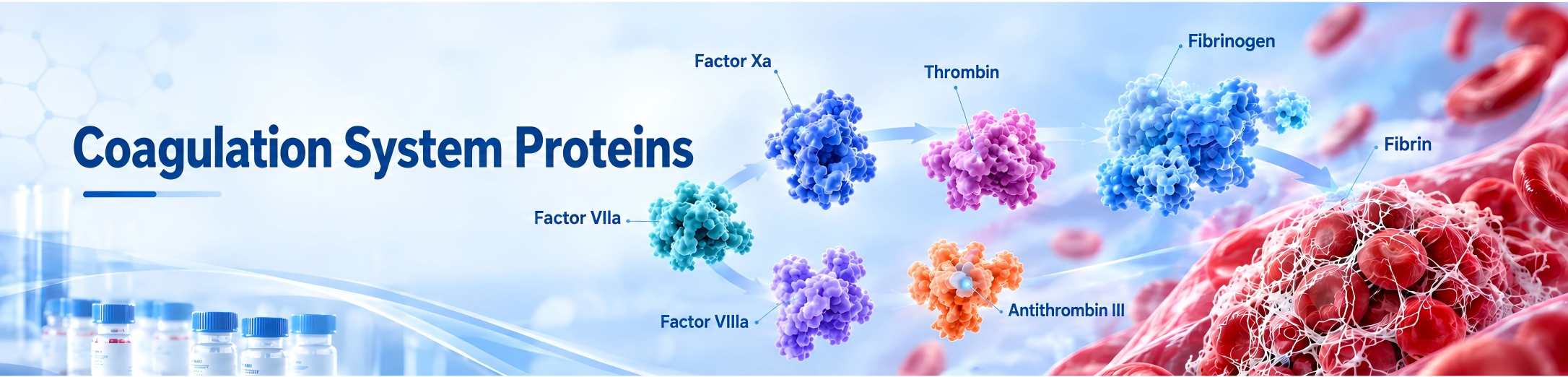
The coagulation system constitutes a central component of hemostasis and is essential for limiting blood loss following vascular injury. Its principal function is to generate thrombin through a tightly regulated cascade of proteolytic reactions, culminating in the conversion of soluble fibrinogen into insoluble fibrin and the formation of a stable hemostatic clot. Physiological hemostasis, however, is not mediated by coagulation factors alone, but rather arises from the coordinated interplay among the vascular endothelium, platelets, plasma coagulation factors, endogenous anticoagulant pathways, and the fibrinolytic system.
Traditionally, the coagulation cascade has been divided into the extrinsic, intrinsic, and common pathways. Although this framework remains useful for interpreting conventional coagulation assays such as prothrombin time (PT) and activated partial thromboplastin time (aPTT), it does not fully recapitulate the spatial and cellular organization of coagulation in vivo. Current models indicate that physiological coagulation is initiated predominantly by exposure of tissue factor (TF) at sites of vascular injury. TF binds activated factor VII (FVIIa) to form the TF–FVIIa complex, which activates factor X (FX) and factor IX (FIX), thereby generating an initial, limited amount of thrombin. This early thrombin subsequently activates platelets and several coagulation cofactors, including factor V (FV), factor VIII (FVIII), and factor XI (FXI). On the surface of activated platelets, activated factor VIII (FVIIIa) associates with activated factor IX (FIXa) to form the intrinsic tenase complex, which markedly enhances the conversion of FX to activated factor X (FXa). FXa, together with activated factor V (FVa), forms the prothrombinase complex and drives the rapid generation of large amounts of thrombin, a process commonly referred to as the “thrombin burst”.
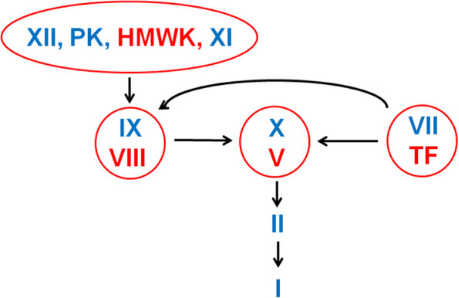
Thrombin is the central effector protease of the coagulation network. In addition to amplifying coagulation through multiple positive-feedback mechanisms, thrombin cleaves fibrinogen to generate fibrin monomers and activates factor XIII (FXIII), which subsequently cross-links fibrin polymers to produce a mechanically stable fibrin network. This fibrin meshwork reinforces the primary platelet plug and stabilizes the developing hemostatic clot. By contrast, the factor XII (FXII)-dependent contact activation pathway, although fundamental to the aPTT assay and the classical intrinsic pathway model, is now considered largely dispensable for normal physiological hemostasis. Instead, accumulating evidence suggests that contact activation contributes more prominently to pathological thrombosis and inflammation.
To confine clot formation to the site of vascular injury and prevent uncontrolled thrombin generation, coagulation is counterbalanced by several endogenous anticoagulant mechanisms. Antithrombin inhibits thrombin and FXa, as well as several other activated serine proteases within the coagulation cascade. Tissue factor pathway inhibitor (TFPI) primarily restricts TF–FVIIa-dependent initiation, whereas the protein C–protein S anticoagulant pathway attenuates coagulation amplification through proteolytic inactivation of FVa and FVIIIa. Following vascular repair, the fibrinolytic system promotes clot resolution. Tissue-type plasminogen activator (tPA) converts plasminogen into plasmin, which degrades cross-linked fibrin and facilitates the progressive removal of the thrombus. Thus, physiological coagulation should be regarded not simply as a clot-forming process, but as a dynamic equilibrium among procoagulant, anticoagulant, and fibrinolytic pathways.
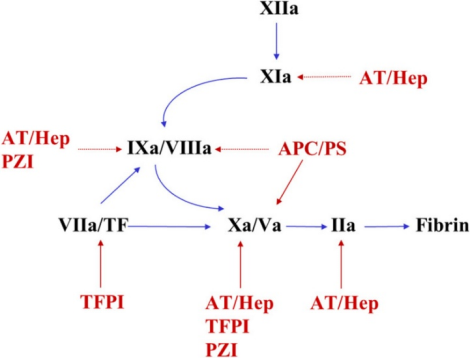
Overall, the human coagulation system can be conceptualized as a highly regulated network characterized by tissue factor-dependent initiation, thrombin generation and amplification, fibrin formation and stabilization, and subsequent limitation by anticoagulant and fibrinolytic mechanisms. This integrated architecture enables rapid and spatially restricted clot formation at sites of vascular injury while preserving blood fluidity throughout the remainder of the circulation. Disruption of this finely balanced system can result in a broad spectrum of pathological conditions, including bleeding disorders, arterial and venous thrombosis, and disseminated intravascular coagulation.
▋Related products
| Product Name | Catalog# |
| NebuSelect™ Native Human Factor XIIIa | NBL-301988 |
| NebuSelect™ Native Human Factor 13 / Factor XIII | NBL-301989 |
| NebuSelect™ Native Human Factor 12 / Factor XII | NBL-301990 |
| NebuSelect™ Native Human Factor 11a / Factor XIa | NBL-301991 |
| NebuSelect™ Native Human Factor 11 / Factor XI | NBL-301992 |
| NebuSelect™ Native Human Factor 10a / Factor Xa | NBL-301993 |
| NebuSelect™ Native Human Factor 10 / Factor X | NBL-301994 |
| NebuSelect™ Native Human Factor 7a / Factor VIIa | NBL-301995 |
| NebuSelect™ Native Human Factor 7 / Factor VII | NBL-301996 |
| NebuSelect™ Native Human Factor 5a / Factor Va | NBL-301997 |
| NebuSelect™ Native Human Factor 5 / Factor V | NBL-301998 |
| NebuSelect™ Native Human Factor IXa Beta | NBL-301999 |
| NebuSelect™ Native Human Factor 9 / Factor IX | NBL-302000 |
| NebuSelect™ Native Human Factor 12a / Factor alpha-XIIa | NBL-302001 |
| NebuSelect™ Native Bovine Factor XIa | NBL-302062 |
| NebuSelect™ Native Bovine Factor IX | NBL-302063 |
| NebuSelect™ Native Mouse Thrombin | NBL-301934 |
| NebuSelect™ Native Mouse AT3 / Antithrombin III | NBL-301937 |
| NebuSelect™ Native Human Factor II / Prothrombin | NBL-301950 |
| NebuSelect™ Native Human AT3 / Antithrombin III | NBL-302049 |
| NebuSelect™ Native Human alpha-Thrombin | NBL-302051 |
| NebuSelect™ Native Human LMW / Kininogen | NBL-301964 |
| NebuSelect™ Native Human HMW / Kininogen | NBL-301965 |
| NebuSelect™ Native Human Kallikrein | NBL-301966 |
| NebuSelect™ Native Human PLG / Plasminogen | NBL-301957 |
| NebuSelect™ Native Human tPA / Tissue-type Plasminogen Activator | NBL-301945 |
| NebuSelect™ Native Human Plasmin | NBL-301958 |
| NebuSelect™ Native Human alpha-2-Antiplasmin | NBL-302054 |
| NebuSelect™ Native Human PK / Prekallikrein | NBL-301954 |
| NebuSelect™ Native Swine Fibrinogen | NBL-301926 |
| NebuSelect™ Native Rat Fibrinogen Protein | NBL-301929 |
| NebuSelect™ Native Rabbit Fibrinogen | NBL-301932 |
| NebuSelect™ Native Mouse Fibrinogen | NBL-301936 |
| NebuSelect™ Native Canine Fibrinogen | NBL-302060 |
| NebuSelect™ Native Human Fibronectin | NBL-301985 |
| NebuSelect™ Native Mouse alpha-1-Acid-Glycoprotein | NBL-301939 |
| NebuSelect™ Native Human VWF / Von Willebrand Factor | NBL-301944 |
| NebuSelect™ Native Human TGB / Thyroxine-Binding Globulin | NBL-301946 |
| NebuSelect™ Native Human Superoxide Dismutase | NBL-301947 |
| NebuSelect™ Native Human RBP / Retinol-Binding Protein 4 | NBL-301949 |
| NebuSelect™ Native Human Protein Z | NBL-301951 |
| NebuSelect™ Native Human Protein S | NBL-301952 |
| NebuSelect™ Native Human Protein C | NBL-301953 |
| NebuSelect™ Native Human Transthyretin / TTR / Prealbumin | NBL-301955 |
| NebuSelect™ Native Human PF-4 / Platelet Factor 4 | NBL-301956 |
| NebuSelect™ Native Human MPO / Myeloperoxidase | NBL-301959 |
| NebuSelect™ Native Human Lysozyme | NBL-301960 |
| NebuSelect™ Native Human LRG1 / Leucine-rich Alpha-2-Glycoprotein | NBL-301962 |
| NebuSelect™ Native Human IAIP / Inter Alpha Inhibitor | NBL-301967 |
| NebuSelect™ Native Human Angiotensinogen | NBL-302050 |
| NebuSelect™ Native Human AFP / alpha-Fetoprotein | NBL-302052 |
| NebuSelect™ Native Human A1AT / alpha-1-Antitrypsin | NBL-302056 |
| NebuSelect™ Native Human AACT / alpha-1-Antichymotrypsin | NBL-302057 |
| NebuSelect™ Native Human AGP / alpha-1-Acid-Glycoprotein | NBL-302058 |
| NebuSelect™ Native Human Hemopexin | NBL-301979 |
| NebuSelect™ Native Human AHSG / Fetuin-A | NBL-301986 |
| NebuSelect™ Native Human GPIIbIIIa | NBL-301983 |
| NebuSelect™ Native Human ELA2 / Neutrophil Elastase | NBL-302002 |
| NebuSelect™ Native Human Azurocidin | NBL-302040 |
| NebuSelect™ Native Human Chymotrypsin | NBL-302030 |
| NebuSelect™ Native Human Ceruloplasmin | NBL-302031 |
| NebuSelect™ Native Human Cathepsin G | NBL-302032 |
| NebuSelect™ Native Human CTSD / Cathepsin D | NBL-302033 |
| NebuSelect™ Native Human Catalase | NBL-302034 |
| NebuSelect™ Native Human Calpain-1 | NBL-302035 |
| NebuSelect™ Native Human C1 esterase inhibitor | NBL-302036 |
| NebuSelect™ Native Human CRP / C-Reactive Protein | NBL-302037 |
| NebuSelect™ Native Human BCHE / Butyrylcholinesterase | NBL-302038 |
References
1. Park S, Park JK. 2024. Back to basics: the coagulation pathway. Blood Research.