
 +86-15801534258
 info@nebulabio.cn
+86-15801534258
info@nebulabio.cn
info@nebulabio.cn
+86-15801534258
info@nebulabio.cn
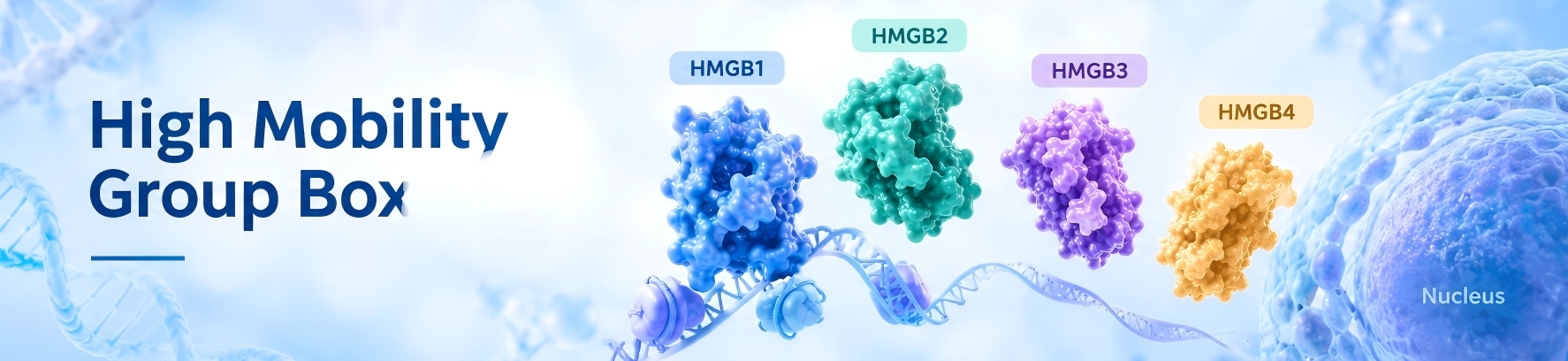
High mobility group box proteins (HMGBs) constitute a highly conserved family of non-histone chromatin-binding proteins with important roles in chromatin organization, DNA replication and repair, transcriptional regulation, cell differentiation, and damage-associated inflammatory responses. The mammalian HMGB family comprises four major members, HMGB1, HMGB2, HMGB3, and HMGB4. HMGB1, HMGB2, and HMGB3 share a common structural organization consisting of two DNA-binding HMG-box domains, termed the A box and B box, followed by an acidic C-terminal tail. HMGB4 also contains two HMG-box domains but lacks the characteristic acidic C-terminal tail. Rather than recognizing a highly specific DNA sequence, HMGB proteins preferentially interact with bent, distorted, or otherwise structurally unusual DNA. By modifying local DNA conformation, they facilitate the recruitment and assembly of transcription factors, chromatin-remodelling complexes, and DNA-repair proteins and therefore function as important architectural regulators of chromatin.
HMGB1 is by far the most extensively characterized member of this family. Under homeostatic conditions, HMGB1 is located predominantly in the nucleus, where it associates dynamically with nucleosomes and DNA, promotes chromatin plasticity, and participates in transcription, DNA replication, recombination, and DNA-damage repair. During infection, inflammation, or tissue injury, HMGB1 can undergo post-translational modifications such as acetylation, translocate from the nucleus to the cytoplasm, and subsequently be actively secreted by activated macrophages, monocytes, and other cell types. In parallel, HMGB1 can be passively released from necrotic or severely damaged cells. Once present in the extracellular environment, HMGB1 functions as a prototypical damage-associated molecular pattern (DAMP), or alarmin, thereby converting intracellular tissue-damage signals into local and systemic immune responses.
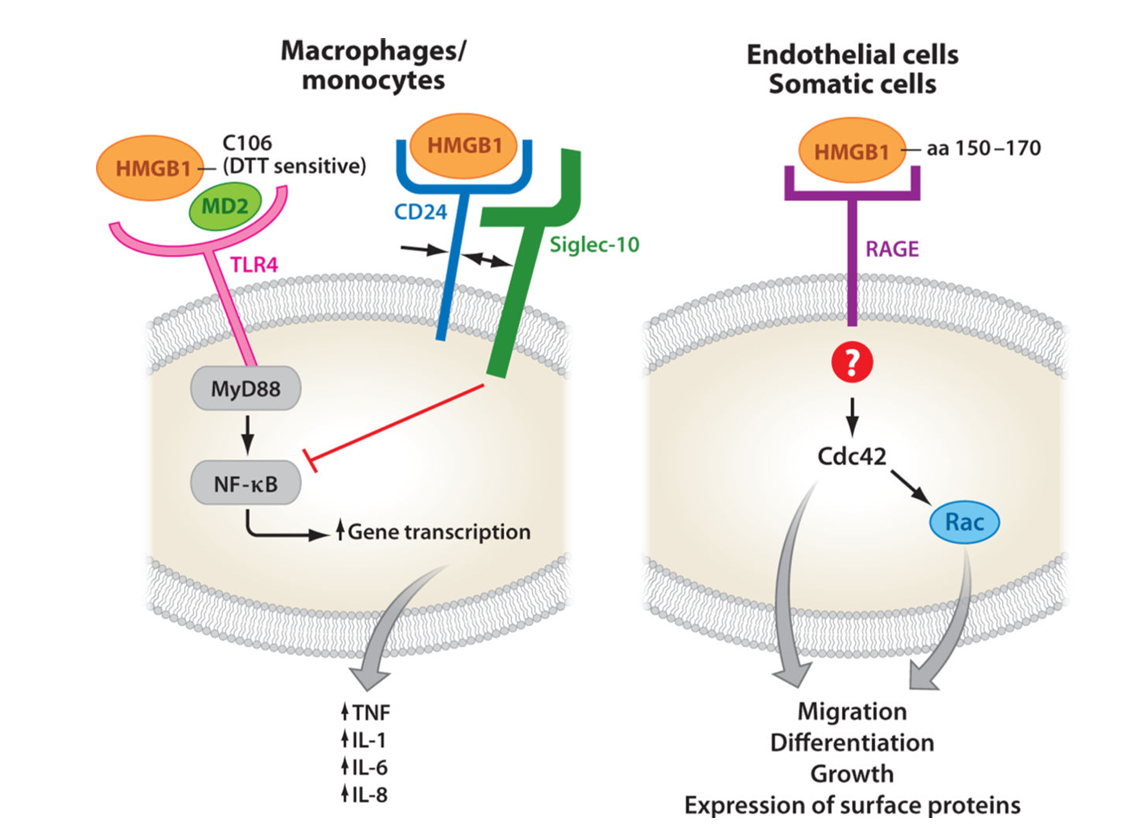
Extracellular HMGB1 interacts with several receptors and co-receptors, among which the receptor for advanced glycation end products (RAGE) and Toll-like receptor 4 (TLR4) have been particularly well characterized. Engagement of these pattern-recognition pathways can activate NF-κB and MAPK signalling and promote the production of inflammatory mediators including TNF, IL-1, and IL-6, while modulating the activation of macrophages, dendritic cells, and other immune populations. HMGB1 can also form a heterocomplex with the chemokine CXCL12, which promotes inflammatory-cell recruitment through CXCR4. Importantly, the extracellular activities of HMGB1 are not uniform but are tightly regulated by its redox state, post-translational modifications, and molecular binding partners. Distinct molecular forms can preferentially mediate leukocyte recruitment, pro-inflammatory cytokine production, or biological inactivation.
Compared with HMGB1, HMGB2 functions predominantly as an intranuclear chromatin regulator and contributes to transcriptional control, higher-order genome organization, cellular proliferation, and senescence. Loss of HMGB2 during entry into cellular senescence has been associated with substantial alterations in chromatin organization and CTCF distribution. HMGB3 is preferentially expressed in embryonic and immature haematopoietic populations and contributes to the regulation of haematopoietic stem and progenitor cell self-renewal and myeloid and B-cell differentiation; aberrantly increased HMGB3 expression has also been reported in multiple malignancies. HMGB4 displays a considerably more restricted expression pattern and is enriched in testicular germ cells and selected neuronal populations, where it contributes to cell-specific transcriptional and differentiation programmes. Collectively, the HMGB family links chromatin architecture and cell-fate regulation with the sensing of tissue injury. HMGB1, in particular, provides a molecular bridge between nuclear homeostasis and extracellular innate immunity. Dysregulated HMGB1 release and signalling have been implicated in sepsis, autoimmune disorders, ischaemia–reperfusion injury, neuroinflammation, and cancer, making the HMGB1 signalling network a potential source of both biomarkers and therapeutic targets.
▋Related products
| Product Name | Catalog# |
| NebuSelect™ Recombinant Human HMGB2, 1-195aa | NBL-302064 |
| NebuSelect™ Recombinant Human HMGB1 Protein, 1-215aa, His-tag | NBL-297755 |
| NebuSelect™ Recombinant Human HMGB1, 1-215aa, His-tag | NBL-250933 |
| NebuSelect™ Recombinant Human HMGB1, His-tag | NBL-250331 |
| NebuSelect™ Recombinant Human HMGB1, His-tag | NBL-246908 |
| NebuSelect™ Recombinant Human HMGB1, 1-215aa, His-tag | NBL-244620 |
| NebuSelect™ Recombinant Human HMGB1, His-tag | NBL-242545 |
| NebuSelect™ Recombinant Human HMGB1 (C23S, C45S, C106S) | NBL-302065 |
| NebuSelect™ Recombinant Human HMGB1 BOXA, 1-89aa | NBL-302066 |
| NebuSelect™ Recombinant Human HMGB1 (C23, C45, C106 Oxidized) | NBL-302067 |
| NebuSelect™ Recombinant Human HMGB1 BOXA&B, 1-176aa | NBL-302068 |
| NebuSelect™ Recombinant Human HMGB1 BOXB, 90-176aa | NBL-302069 |
| NebuSelect™ Recombinant Human HMGB1 BOXA (C23D, C45D), 1-89aa | NBL-302070 |
| NebuSelect™ Recombinant Biotinylated Human HMGB1 , His-tag | NBL-241786 |
| NebuSelect™ Recombinant Human HMGB2, 1-209aa, His-tag | NBL-244621 |
| NebuSelect™ Recombinant Human HMGB3, 1-180aa, His-tag | NBL-244622 |
| NebuSelect™ Recombinant Human HMGB1, MARI-tag | NBL-247414 |
| NebuSelect™ Recombinant Human HMGB3, His-tag | NBL-247419 |
| NebuSelect™ Recombinant Human HMGB2, His-tag | NBL-247876 |
| NebuSelect™ Recombinant Mouse HMGB1/HMG1, His-tag | NBL-249258 |
| NebuTools™ Human HMGB1 Cell Line | NBST-249906 |
| NebuTools™ Human HMGB2 Cell Line | NBST-249907 |
| NebuTools™ Human HMGB3 Cell Line | NBST-249908 |
| NebuTools™ Human HMGB4 Cell Line | NBST-249909 |
| NebuSelect™ Recombinant High Mobility Group Protein 1 (HMGB1), 1-215aa, His-tag | NBL-252744 |
| NebuSelect™ Recombinant Human HMGB1, His-tag | NBL-289050 |
| NebuSelect™ Recombinant Mouse HMGB1 Protein, 1-215aa, His-tag | NBL-292995 |
| NebuSelect™ Recombinant Human HMGB3 Protein, 14-176aa, His-tag | NBL-294094 |
| NebuSelect™ Recombinant Human HMGB2 Protein, 2-187aa, His-tag | NBL-294429 |
| NebuSelect™ Recombinant Human HMGB4 Protein, 25-167aa, His-tag | NBL-295051 |
| NebuSelect™ Recombinant Human HMGB1 Protein, 1-215aa, His-tag | NBL-299366 |
References
1. Park S, Park JK. 2024. Back to basics: the coagulation pathway. Blood Research.