
 +86-15801534258
 info@nebulabio.cn
+86-15801534258
info@nebulabio.cn
info@nebulabio.cn
+86-15801534258
info@nebulabio.cn
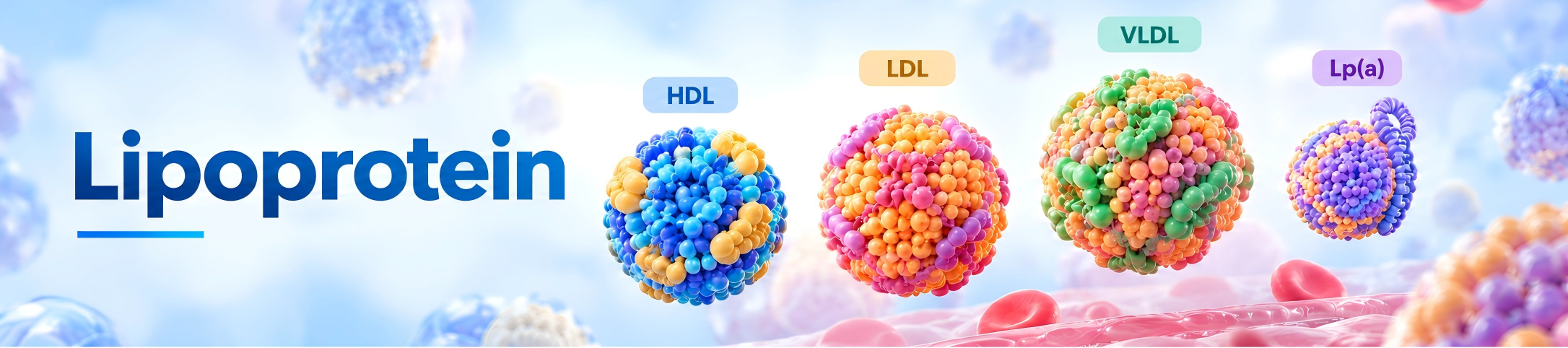
Lipoproteins are spherical macromolecular complexes composed of lipids and apolipoproteins whose principal function is to transport cholesterol, triglycerides, and other lipid-soluble molecules through the aqueous environment of plasma. A typical lipoprotein particle consists of a hydrophobic core containing predominantly cholesteryl esters and triglycerides, surrounded by an amphipathic surface monolayer composed of phospholipids, unesterified cholesterol, and apolipoproteins. In addition to maintaining particle structure, apolipoproteins participate in receptor recognition and regulate key enzymes involved in lipid metabolism. According to their density, size, and composition, circulating lipoproteins are classified mainly as chylomicrons, very-low-density lipoproteins (VLDL), intermediate-density lipoproteins (IDL), low-density lipoproteins (LDL), and high-density lipoproteins (HDL). Lipoprotein(a) [Lp(a)] represents an additional lipoprotein class with independent relevance to cardiovascular risk.
Lipoprotein metabolism comprises two major transport pathways, conventionally referred to as the exogenous and endogenous pathways. Following intestinal absorption, dietary lipids are assembled into chylomicrons containing apolipoprotein B-48 (apoB-48) and released into the circulation. Their triglyceride content is hydrolysed by lipoprotein lipase, thereby supplying fatty acids to skeletal muscle and adipose tissue, whereas the resulting chylomicron remnants are ultimately taken up by the liver. In contrast, triglycerides and cholesterol synthesized or repackaged by the liver are secreted predominantly within apoB-100-containing VLDL particles. Progressive lipolysis of VLDL produces IDL and subsequently cholesterol-enriched LDL. LDL delivers cholesterol to peripheral tissues through LDL receptor-mediated endocytosis, whereas hepatic LDL receptors constitute a major pathway for the clearance of circulating LDL and therefore play a central role in determining plasma LDL concentrations.
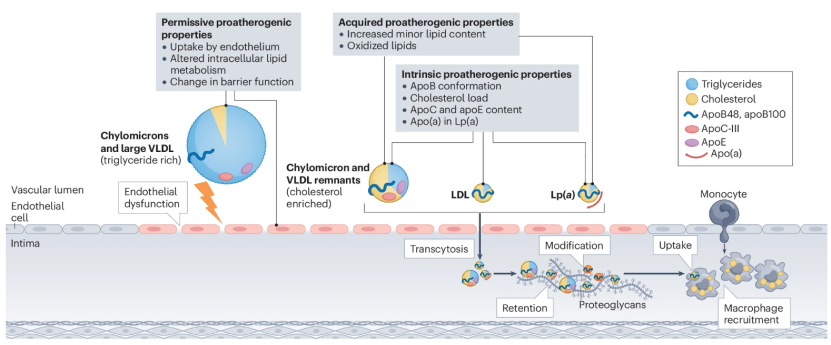
LDL and other apoB-containing lipoproteins have a well-established causal role in the development of atherosclerosis. After apoB-containing particles enter and become retained within the arterial intima, they can undergo oxidation, aggregation, and other forms of modification, initiating endothelial dysfunction, monocyte recruitment, and local inflammatory responses. Continued uptake of modified lipoproteins by macrophages promotes foam-cell formation and contributes to the development of lipid-rich cores, necrotic regions, and fibrous atherosclerotic plaques. Consequently, atherosclerotic risk is determined not only by the amount of cholesterol carried within LDL particles but also by the number of circulating atherogenic apoB-containing particles and the cumulative duration of arterial exposure to these particles. Remnants of triglyceride-rich lipoproteins and Lp(a) are also apoB-containing particles and independently contribute to atherosclerotic cardiovascular disease.
HDL contains apoA-I as its principal structural apolipoprotein and participates in the acquisition of cholesterol from peripheral cells and its subsequent transport towards the liver, a process commonly referred to as reverse cholesterol transport. HDL particles can additionally modulate inflammatory responses, oxidative stress, and endothelial function. However, the concentration of HDL cholesterol does not fully reflect the functional properties of HDL particles, and pharmacologically increasing HDL-C alone does not necessarily translate into a reduction in cardiovascular risk. Routine clinical lipid assessment generally includes total cholesterol, triglycerides, LDL-C, and HDL-C, with non-HDL-C, apoB, and Lp(a) providing additional information when appropriate. LDL-C remains the principal therapeutic target in lipid-lowering strategies, whereas apoB provides an estimate of the total number of circulating atherogenic particles and can be particularly informative in patients with hypertriglyceridaemia, diabetes, obesity, or discordance between LDL-C concentration and particle number. Integrated assessment of lipoprotein concentrations, composition, and particle burden therefore enables a more accurate evaluation of lipid metabolism and atherosclerotic cardiovascular risk.
▋Related products
| Product Name | Catalog# |
| NebuSelect™ Recombinant Mouse APOE/Apolipoprotein E, His-tag | NBL-241055 |
| NebuSelect™ Recombinant Human APOE4/Apolipoprotein E, hFc-tag | NBL-241056 |
| NebuSelect™ Recombinant Biotinylated Human APOE3/Apolipoprotein E, Avi-His-tag | NBL-241131 |
| NebuSelect™ Recombinant Human APOE2/Apolipoprotein E, His-tag | NBL-241265 |
| NebuSelect™ Recombinant Human APOE3/Apolipoprotein E, hFc-tag | NBL-241545 |
| NebuSelect™ Recombinant Human APOE4/Apolipoprotein E, His-tag | NBL-241571 |
| NebuSelect™ Recombinant Mouse APOE/Apolipoprotein E, hFc-tag | NBL-243088 |
| NebuSelect™ Recombinant Biotinylated Human APOE3/Apolipoprotein E, His-tag | NBL-243091 |
| NebuSelect™ Recombinant Human APOE3/Apolipoprotein E, His-tag | NBL-243092 |
| NebuSelect™ Recombinant Human Apolipoprotein A-1, 25-267aa, His-tag | NBL-243356 |
| NebuSelect™ Recombinant Human Apolipoprotein A1, His-tag | NBL-246828 |
| NebuSelect™ Recombinant Human Apolipoprotein A-I | NBL-246880 |
| NebuSelect™ Recombinant Human Apolipoprotein A-IV, His-tag | NBL-247930 |
| NebuSelect™ Recombinant Human Apolipoprotein J, His-tag | NBL-249765 |
| NebuSelect™ Recombinant Human Apolipoprotein E, 19-317aa, His-tag | NBL-250878 |
| NebuSelect™ Recombinant Human Apolipoprotein B, 28-127aa, His-tag | NBL-250884 |
| NebuSelect™ Recombinant Human Apolipoprotein A1/ApoA1 Protein(C-6His), 122-267aa, His-tag | NBL-251665 |
| NebuSelect™ Recombinant Apolipoprotein E (APOE), 19-181aa, His-tag | NBL-251828 |
| NebuSelect™ Recombinant Apolipoprotein A2 (APOA2), 24-100aa, His-tag | NBL-251888 |
| NebuSelect™ Recombinant Apolipoprotein D (APOD), 1-189aa, His-tag, GST-tag | NBL-251936 |
| NebuSelect™ Recombinant Low Density Lipoprotein Receptor Related Protein 1 (LRP1), 692-962aa, His-tag | NBL-252025 |
| NebuSelect™ Recombinant Human Apolipoprotein B100 (APOB100), 3365-3548aa, His-tag | NBL-252172 |
| NebuSelect™ Recombinant Human Apolipoprotein D (APOD), 21-189aa, His-tag | NBL-252193 |
| NebuSelect™ Recombinant Apolipoprotein B (APOB), 3360-3526aa, His-tag | NBL-252471 |
| NebuSelect™ Recombinant Apolipoprotein A4 (APOA4), 21-235aa, His-tag, GST-tag | NBL-252579 |
| NebuSelect™ Recombinant Low Density Lipoprotein Receptor Related Protein 1 (LRP1), 20-429aa, His-tag | NBL-252590 |
| NebuSelect™ Recombinant Low Density Lipoprotein Receptor Related Protein 2 (LRP2), 4035-4184aa, His-tag | NBL-252649 |
| NebuSelect™ Recombinant Apolipoprotein A5 (APOA5), 21-210aa, His-tag, GST-tag | NBL-252891 |
| NebuSelect™ Recombinant Apolipoprotein E (APOE), 14-167aa, His-tag, GST-tag | NBL-252900 |
| NebuSelect™ Apolipoprotein E from Human Plasma | NBL-253006 |
| NebuSelect™ Recombinant Human Apolipoprotein D (Apo-D) | NBL-253016 |
| NebuSelect™ Recombinant Human Apolipoprotein J (Apo-J) | NBL-253017 |
| NebuSelect™ Recombinant Human Apolipoprotein A-I (ApoA-I) | NBL-253019 |
| NebuSelect™ Native Human Apolipoprotein A-I (Apo A-I) | NBL-286521 |
| NebuSelect™ Native Human Apolipoprotein A-II (Apo A-II) | NBL-286522 |
| NebuSelect™ Native Human Apolipoprotein AIV (Apo A-IV) | NBL-286523 |
| NebuSelect™ Native Human Apolipoprotein B (Apo B) | NBL-286524 |
| NebuSelect™ Native Human Apolipoprotein C-I (Apo C-I) | NBL-286525 |
| NebuSelect™ Native Human Apolipoprotein C-II (Apo C-II) | NBL-286526 |
| NebuSelect™ Native Human Very Low-Density Lipoprotein (VLDL), Premium | NBL-286527 |
| NebuSelect™ Native Human Very Low-Density Lipoprotein (VLDL) | NBL-286528 |
| NebuSelect™ Native Human Oxidized Low-Density Lipoprotein | NBL-286529 |
| NebuSelect™ Native Human Low-Density Lipoproteins (LDL), Premium | NBL-286530 |
| NebuSelect™ Native Human Low-Density Lipoproteins (LDL) | NBL-286531 |
| NebuSelect™ Native Human Intermediate-Density Lipoprotein (IDL) | NBL-286532 |
| NebuSelect™ Native Human High-Density Lipoprotein (HDL), Premium | NBL-286533 |
| NebuSelect™ Native Human High-Density Lipoprotein (HDL) | NBL-286534 |
| NebuSelect™ Native Human Lipoprotein(a), Lp(a) | NBL-286535 |
| NebuSelect™ Native Human Apolipoprotein E (Apo-E) | NBL-286537 |
| NebuSelect™ Native Human Apolipoprotein C-III (apo C-III) | NBL-286538 |
| NebuSelect™ Recombinant Human Low-density lipoprotein receptor, His-tag | NBL-289326 |
| NebuSelect™ Recombinant Human Low-density lipoprotein receptor, Avi-His-tag | NBL-289327 |
| NebuSelect™ Native Human HDL / High Density Lipoprotein | NBL-301978 |
| NebuSelect™ Native Human LDL / Low Density Lipoprotein | NBL-301961 |
| NebuSelect™ Native Human Apo H / Apolipoprotein H | NBL-302041 |
| NebuSelect™ Native Human Apo E / Apolipoprotein E | NBL-302042 |
| NebuSelect™ Native Human Apo C3 / Apolipoprotein C-III | NBL-302043 |
| NebuSelect™ Native Human Apo C2 / Apolipoprotein C-II | NBL-302044 |
| NebuSelect™ Native Human Apo C1 / Apolipoprotein C-I | NBL-302045 |
| NebuSelect™ Native Human Apo B / Apolipoprotein B | NBL-302046 |
| NebuSelect™ Native Human Apo A2 / Apolipoprotein A-II | NBL-302047 |
| NebuSelect™ Native Human Apo A / Apolipoprotein A-I | NBL-302048 |
References
1. Park S, Park JK. 2024. Back to basics: the coagulation pathway. Blood Research.