
 +86-15801534258
 info@nebulabio.cn
+86-15801534258
info@nebulabio.cn
Saponins are a structurally complex class of glycosidic natural products, named for the soap-like persistent foam produced when their aqueous solutions are shaken. They occur in more than a hundred plant families, including Panax, Notoginseng, Glycyrrhiza, soybean, Dioscorea, Yucca and Quillaja, and several thousand individual compounds have been characterized. Each molecule consists of a hydrophobic sapogenin—usually triterpenoid (oleanane-type, e.g. oleanolic acid, glycyrrhizin and soyasaponins; dammarane-type, e.g. ginsenosides), less often steroidal (spirostane-type, e.g. diosgenin)—joined through glycosidic bonds to one or more hydrophilic sugar chains built from glucose, rhamnose, arabinose, xylose and glucuronic acid.
This "hydrophobic sapogenin + hydrophilic sugar chain" architecture underlies most saponin behaviour. The sapogenin fixes the skeleton and the degree of hydrophobicity, while the sugar chains tune water solubility and potency; the combinatorial diversity of the two accounts for the size and the broad activity spectrum of the family. Sugar chains can be attached at different positions of the aglycone (e.g. ginsenoside Rb1 carries sugars at C-3 and C-20), and Fig. 1 shows the general structure and representative skeletons. Saponins are usually white amorphous powders with a bitter taste, soluble in water, methanol, dilute ethanol and n-butanol but nearly insoluble in non-polar solvents; most of them form insoluble complexes with cholesterol, the basis of the cholesterol-precipitation method for removing saponins.
Most macroscopic properties of saponins can be understood from their amphiphilicity. At the air–water interface the molecules orient with the hydrophobic sapogenin toward air and the sugar chains in water, markedly lowering the surface tension—the direct cause of foaming and emulsification; above the critical micelle concentration they self-assemble into micelles that solubilize poorly soluble solutes. In biological membranes, the hydrophobic aglycone inserts into the lipid bilayer and binds cholesterol specifically, perturbing phospholipid packing and opening pores that impair the barrier function of the membrane; haemolysis, antimicrobial activity and the immunoadjuvant effect have all been attributed to this membrane-perturbation mechanism.
Compared with synthetic surfactants, saponins are natural, biodegradable and mild, and the combination of aglycone type, sugar composition and linkage pattern leaves a large space for structure–activity tuning. In medicine, QS-21 from Quillaja bark is a core component of the adjuvant systems of the shingles vaccine Shingrix and the malaria vaccine Mosquirix; glycyrrhizin preparations are used for liver protection, ginsenoside Rg3 as an adjunct in cancer therapy, and diosgenin remains a long-standing raw material for the semi-synthesis of steroidal drugs. In food, Quillaja bark extract (EU additive E999) acts as a natural foaming and emulsifying agent, glycyrrhizin also serves as a sweetener, and Yucca and tea-saponin extracts are used as feed additives; in personal care and agriculture, saponins enter toothpastes and cosmetic formulations, and tea saponin is a registered botanical molluscicide. The main drawbacks are haemolysis of crude fractions, the high cost of isolating individual compounds that occur at low abundance, and the poor oral bioavailability of intact glycosides.
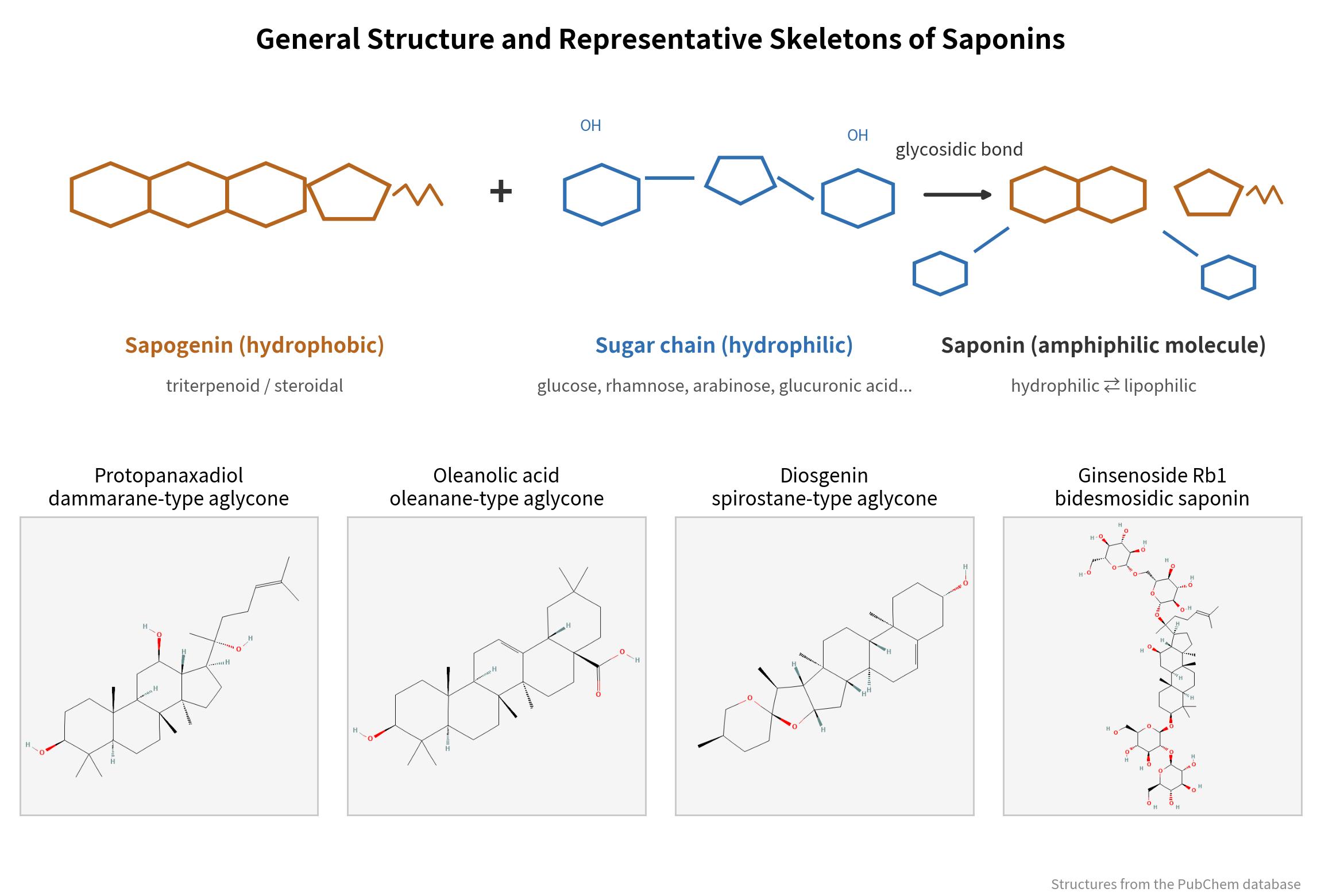
Fig. 1 General structure and representative skeletons of saponins (upper: sapogenin joined to sugar chains via glycosidic bonds; lower: protopanaxadiol, oleanolic acid, diosgenin and ginsenoside Rb1, structures from PubChem)
▋Related products
| Product Name | Catalog# | CAS# | Formula | Molecular Weight | |
| Ginsenoside Rb1 | NBC-234225 | 41753-43-9 | C54H92O23 | 1108.6 | Inquire |
| Ginsenoside Rb2 | NBC-234226 | 11021-13-9 | C53H90O22 | 1078.6 | Inquire |
| Ginsenoside Rd | NBC-234227 | 52705-93-8 | C48H82O18 | 946.6 | Inquire |
| Ginsenoside Rg3 | NBC-234228 | 14197-60-5 | C42H72O13 | 784.5 | Inquire |
| Ginsenoside F2 | NBC-234229 | 62025-49-4 | C42H72O13 | 784.5 | Inquire |
| Ginsenoside C-K | NBC-234230 | 39262-14-1 | C36H62O8 | 622.4 | Inquire |
| Ginsenoside Rh2 | NBC-234231 | 67400-17-3 | C36H62O8 | 622.4 | Inquire |
| (20S)-Protopanaxadiol | NBC-234232 | 30636-90-9 | C30H52O3 | 460.4 | Inquire |
| Ginsenoside Rb3 | NBC-234233 | 68406-26-8 | C53H90O22 | 1078.6 | Inquire |
| Gypenoside XVII | NBC-234234 | 80321-69-3 | C48H82O18 | 946.6 | Inquire |
| Gypenoside LXXV | NBC-234235 | 110261-98-8 | C42H72O13 | 784.5 | Inquire |
| Ginsenoside Re | NBC-234236 | 52286-59-6 | C48H82O18 | 946.6 | Inquire |
| Ginsenoside Rg1 | NBC-234237 | 22427-39-0 | C42H72O14 | 800.5 | Inquire |
| Ginsenoside F1 | NBC-234238 | 53963-43-2 | C36H62O9 | 638.4 | Inquire |
| Ginsenoside Rg2 | NBC-234239 | 52286-74-5 | C42H72O13 | 784.5 | Inquire |
| Ginsenoside Rh1 | NBC-234240 | 63223-86-9 | C36H62O9 | 638.4 | Inquire |
| Ginsenoside Rf | NBC-234241 | 52286-58-5 | C42H72O14 | 800.5 | Inquire |
| (20S)-Protopanaxatriol | NBC-234242 | 34080-08-5 | C30H52O4 | 476.4 | Inquire |
| Chikusetsu saponinⅣa | NBC-234243 | 51415‑02‑2 | C42H66O14 | 794.97 | Inquire |
| Chikusetsu saponin Ⅳ | NBC-234244 | 7518-22-1 | C47H74O18 | 957.1 | Inquire |
| Chikusetsu saponin Ⅴ | NBC-234245 | 34367-04-9 | C48H76O19 | 1089.21 | Inquire |
| Chikusetsu saponin Ⅱ | NBC-234246 | 59930‑75‑5 | C42H66O14 | 1105.22 | Inquire |
| Soyasaponin Bb | NBC-234247 | 51330‑27‑9 | C48H78O18 | 943.12 | Inquire |
| α‑Solanine | NBC-234248 | 20562‑02‑1 | C45H73NO15 | 868.06 | Inquire |
| α‑Chaconine | NBC-234249 | 20562‑03‑2 | C45H73NO14 | 852.07 | Inquire |
Keywords: saponin, triterpenoid saponin, steroidal saponin, sapogenin, ginsenoside, glycyrrhizin, amphiphilicity, immunoadjuvant, QS-21
References
[1] Moses T, Papadopoulou KK, Osbourn A. Metabolic and functional diversity of saponins, biosynthetic intermediates and semi-synthetic derivatives. Crit Rev Biochem Mol Biol. 2014;49(6):439-462.