
 +86-15801534258
 info@nebulabio.cn
+86-15801534258
info@nebulabio.cn

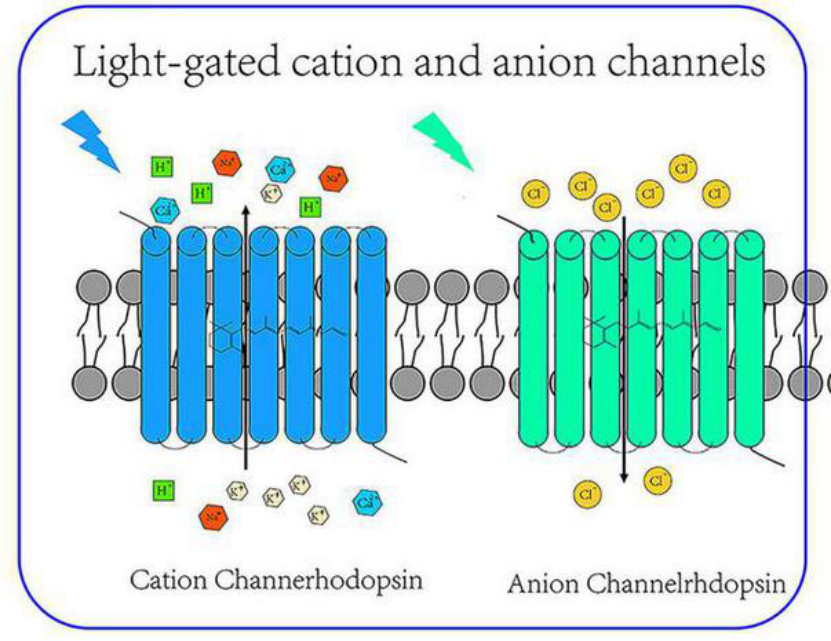
Light-gated ion channels convert optical signals into transmembrane ionic currents and are central tools in optogenetics. In channelrhodopsin-2 (ChR2), blue light triggers isomerization of the retinal chromophore, opening the channel and enabling cation flux that rapidly changes membrane potential. Its seven-transmembrane architecture integrates light sensing and ion conduction within a single protein. Different variants offer distinct spectral responses and channel kinetics. Targeted expression combined with pulsed illumination enables millisecond-scale control of neuronal activity, while channels with different ion selectivities provide tools for cellular excitation or inhibition.[1–3]
As a complementary research strategy, endogenous channels—including TRPV1 (VR1), CaV1.2 (CACNA1C), TRPV4, NaV1.6 (SCN8A), Kir4.1 (KCNJ10), and TRPC3—can be investigated alongside optogenetic stimulation. Antibodies targeting NaV1.5 (SCN5A) (493-511), together with tools such as HCN4 Antibody, may support protein expression and localization analyses when validated for the intended applications. Combining these measurements with electrophysiological recordings can help characterize cellular responses to optogenetic manipulation and the contribution of endogenous channels.
▋Related products
Target | Catalog# | Product Name |
| TRPV1 (VR1) | NBAB-017091 | NebuSelect™ Anti-TRPV1 Polyclonal Antibody |
| CaV1.2 (CACNA1C) | NBAB-012237 | NebuSelect™ Anti-Human CACNA1C Monoclonal Antibody |
| TRPV4 | NBAB-160277 | NebuSelect™ Anti-TRPV4 Polyclonal Antibody |
| NaV1.6 (SCN8A) | NBAB-011306 | NebuSelect™ Anti-Nav1.6 Na+ channel Monoclonal Antibody |
| Kir4.1 (KCNJ10) | NBAB-016883 | NebuSelect™ Anti-KCNJ10 Polyclonal Antibody |
| TRPC3 | NBAB-012782 | NebuSelect™ Anti-Human TRPC3 Nanobody |
| NaV1.5 (SCN5A) (493-511) | NBAB-017649 | NebuSelect™ Anti-Human SCN5A Polyclonal Antibody |
| HCN4 Antibody | NBAB-012545 | NebuSelect™ Anti-Human HCN4 Monoclonal Antibody |
▋References
1. Nagel G, et al. Channelrhodopsin-2, a directly light-gated cation-selective membrane channel. PNAS. 2003;100(24):13940–13945. DOI:10.1073/pnas.1936192100
2. Boyden ES, et al. Millisecond-timescale, genetically targeted optical control of neural activity. Nature Neuroscience. 2005;8(9):1263–1268. DOI:10.1038/nn1525
3. Zhang H, et al. Applications and challenges of rhodopsin-based optogenetics in biomedicine. Frontiers in Neuroscience. 2022;16:966772. DOI:10.3389/fnins.2022.966772