
 +86-15801534258
 info@nebulabio.cn
+86-15801534258
info@nebulabio.cn

FGL1 (Fibrinogen-like Protein 1), also known as Hepassocin, is a secreted protein primarily produced by hepatocytes and belongs to the fibrinogen-related protein family. Its C-terminal region contains a conserved fibrinogen-like domain, although its biological functions differ from those of fibrinogen involved in blood coagulation. FGL1 is associated with the regulation of hepatocyte growth, hepatic metabolic homeostasis, and immune modulation.
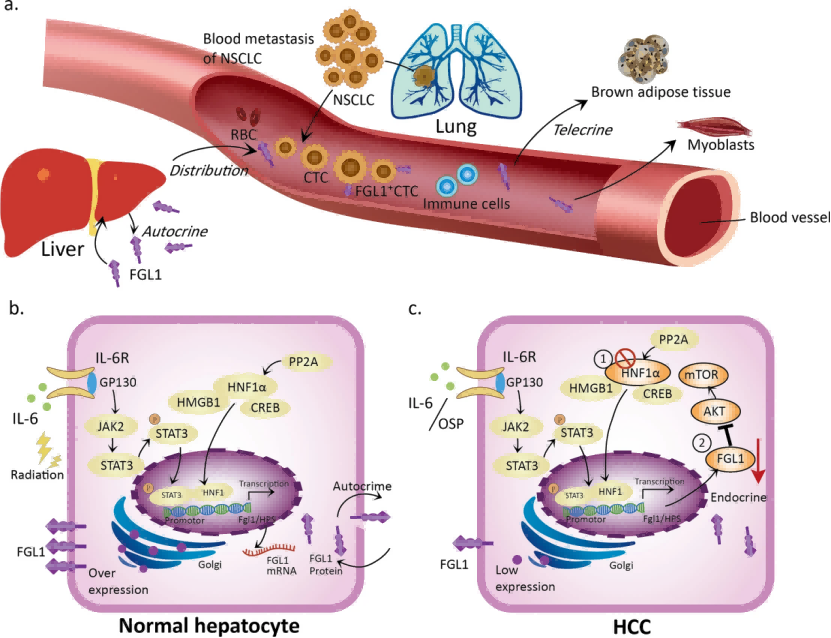
FGL1 is an important ligand of lymphocyte activation gene 3 (LAG-3). Binding of FGL1 to LAG-3 can inhibit antigen-specific T-cell activation, independently of major histocompatibility complex class II (MHC-II). The FGL1/LAG-3 axis represents an immune regulatory pathway distinct from the classical MHC-II/LAG-3 interaction and has attracted considerable interest in studies of T-cell function and the tumor immune microenvironment. FGL1 expression and its interaction with LAG-3 are also relevant to investigations of immune evasion mechanisms.
FGL1 is secreted and contains a fibrinogen-like domain that contributes to its structural characteristics and molecular interactions. The protein can form disulfide-linked homodimers and further assemble into multimeric structures. Its structural state and molecular conformation are associated with protein stability and interaction properties, making these features important for understanding the molecular characteristics of FGL1.
▋Related products
| Product Name | Catalog# | Molecule Weight | Expression System |
| NebuSelect™ Recombinant Human FGL1 Protein, 23-312aa, Fc-tag | NBL-293956 | 62 kDa | HEK293 Cells |
| NebuSelect™ Recombinant Human FGL1 Protein, 23-312aa, His-tag | NBL-293957 | 37 kDa | HEK293 Cells |
| NebuSelect™ Recombinant Human FGL1 Protein, 23-312aa, His-tag | NBL-298973 | 36 kDa | E. coli |
| NebuSelect™ Recombinant Mouse FGL1, 83-314aa, His-tag | NBL-230161 | See COA | E. coli |