
 +86-15801534258
 info@nebulabio.cn
+86-15801534258
info@nebulabio.cn

1. CD161 Molecular Structure and Expression Profile
CD161, also known as NKR-P1A (Natural Killer Receptor-P1A), is a C-type lectin-like receptor (CTLR) encoded by the KLRB1 gene. It belongs to the NKR-P1 receptor family and is expressed primarily on natural killer (NK) cells and subsets of T lymphocytes. Its major known ligand is lectin-like transcript 1 (LLT1), encoded by the CLEC2D gene.
CD161 is a type II transmembrane glycoprotein consisting of an intracellular N-terminal region, a single transmembrane domain, and an extracellular C-type lectin-like domain (CTLD). Unlike classical carbohydrate-binding C-type lectins, CD161 recognizes LLT1 primarily through protein–protein interactions rather than calcium-dependent carbohydrate recognition.
CD161 can form disulfide-linked homodimers at the cell surface. Its extracellular domain adopts a characteristic C-type lectin-like fold that mediates specific interactions with the extracellular domain of LLT1. Structural studies have demonstrated that CD161–LLT1 recognition involves defined receptor–ligand interfaces and higher-order molecular arrangements that may contribute to receptor organization at cell–cell contact sites.
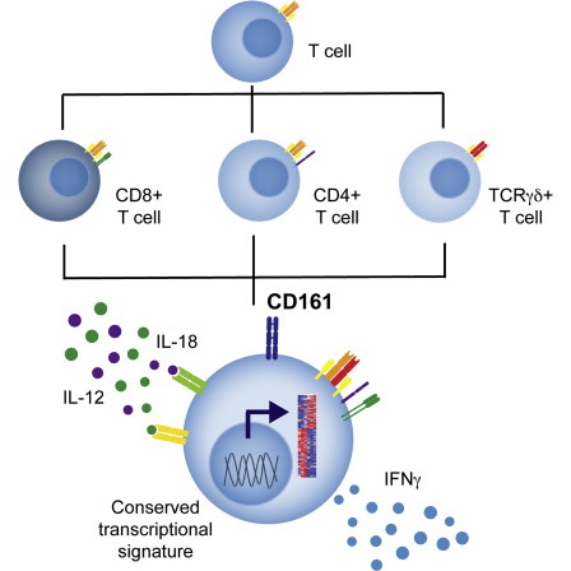
In the human immune system, CD161 is broadly expressed on NK cells and is also found on subsets of CD4+ T cells, CD8+ T cells, γδ T cells, and mucosal-associated invariant T (MAIT) cells. Expression levels vary among immune cell populations and are associated with differences in cellular differentiation, tissue distribution, and functional phenotype.
2. CD161–LLT1 Binding and Signal Regulation
Lectin-like transcript 1 (LLT1), encoded by CLEC2D, is the major known ligand for CD161. LLT1 is another C-type lectin-like protein expressed by activated B cells, T cells, dendritic cells, and other immune cell populations. Its expression is regulated by cellular activation and local immune signals.
CD161 and LLT1 interact through their extracellular C-type lectin-like domains. The interaction generally exhibits relatively low monovalent binding affinity and rapid association–dissociation kinetics. Multivalent receptor–ligand arrangements at the cell surface may enhance the overall stability of cell–cell interactions and influence receptor clustering.
In NK cells, CD161 primarily functions as an inhibitory receptor. Engagement of CD161 by LLT1 can reduce NK-cell degranulation and target-cell cytotoxicity and, under certain conditions, alter the production of cytokines such as interferon-gamma (IFN-γ).
The intracellular region of CD161 contains sequence features associated with signal regulation, although its signaling mechanism differs from that of classical immunoreceptor tyrosine-based inhibitory motif (ITIM)-dependent receptors. CD161-mediated responses are influenced by receptor cross-linking, ligand expression, and signals transmitted through other immune receptors.
In T cells, CD161 exhibits more context-dependent functions. Some studies have demonstrated that CD161 modulates T-cell receptor (TCR)-associated signaling and cytokine production, whereas others have reported inhibitory effects of CD161–LLT1 engagement on specific T-cell populations. Its functional outcome therefore depends on the T-cell subset, activation state, and experimental conditions.
3. Biological Functions of CD161 in NK Cells and T Cells
● CD161-Mediated Regulation of NK-Cell Cytotoxicity
NK cells recognize and eliminate abnormal cells by integrating signals from activating and inhibitory receptors. CD161 is one of the receptors involved in regulating this balance in human NK cells.
When LLT1 is expressed on target cells, its interaction with CD161 on NK cells can suppress NK-cell-mediated cytotoxicity. In certain cellular models, LLT1 expression reduces the susceptibility of target cells to NK-cell-mediated lysis.
CD161-mediated inhibition does not independently determine NK-cell activity. Instead, it operates alongside other activating and inhibitory receptor pathways to influence NK-cell activation thresholds and effector responses.
● CD161 Expression and Functional Differentiation of CD4+ and CD8+ T Cells
CD161 is expressed by several T-cell subsets and is associated with distinct differentiation states and functional phenotypes.
In CD4+ T cells, CD161 is frequently associated with populations exhibiting T helper 17 (Th17)-related characteristics. Th17 cells are characterized by their capacity to produce interleukin-17 (IL-17) and participate in mucosal immunity and inflammatory responses. CD161 can help identify certain T-cell populations with IL-17-producing potential, although CD161 expression is not exclusive to Th17 cells.
In CD8+ T cells, CD161 expression is associated with subsets of memory T cells, tissue-associated T cells, and populations exhibiting distinct cytokine production profiles. CD8+ T-cell subsets with different levels of CD161 expression may vary in proliferative capacity, cytotoxic activity, and cytokine responses.
CD161 serves both as a phenotypic marker and as a receptor capable of modulating T-cell signaling. CD161 positivity alone does not establish a specific functional state, and its interpretation requires consideration of TCR signaling, cellular differentiation, and additional surface markers.
● CD161 and Mucosal-Associated Invariant T Cells
Mucosal-associated invariant T (MAIT) cells are a population of innate-like T lymphocytes that recognize microbial metabolites derived from the riboflavin biosynthesis pathway through the MHC class I-related protein MR1. These cells contribute to mucosal immunity and antimicrobial immune responses.
Typical human peripheral blood MAIT cells express high levels of CD161. Consequently, CD161 is frequently used in combination with the TRAV1-2 (Vα7.2) TCR and MR1 tetramers for MAIT-cell phenotyping.
CD161 is not a MAIT-cell-specific marker. Conventional T-cell subsets and other innate-like T-cell populations may also express CD161. Accurate identification of MAIT cells therefore requires additional phenotypic markers or confirmation of MR1-restricted antigen recognition.
4. CD161–LLT1 Interactions in Tumor Immunology
The CD161–LLT1 signaling axis is involved in regulating immune cell activity within the tumor microenvironment. LLT1 expression has been reported in certain solid tumors and hematologic malignancies, while CD161 may be expressed by tumor-infiltrating NK cells and subsets of T lymphocytes.
In NK cells, LLT1 expressed on tumor cells can engage CD161 and suppress NK-cell-mediated cytotoxicity. In selected tumor models, LLT1 expression has been associated with reduced susceptibility to NK-cell-mediated lysis.
The role of CD161 in tumor-infiltrating T cells depends on the cellular population and surrounding immune environment. Studies have shown that CD161–CLEC2D interactions can suppress T-cell effector functions in certain tumor settings. However, CD161 is also expressed by T-cell populations with memory-associated or activated phenotypes. CD161 expression alone should therefore not be interpreted as evidence of T-cell exhaustion or functional suppression.
The extracellular domain of CD161 mediates LLT1 recognition, providing the structural basis for receptor–ligand interactions at immune cell contact sites. Differences in ligand availability, receptor expression, and cellular signaling contribute to the distinct functions of CD161 in NK cells, T cells, and tumor-associated immune responses.
▋Related products
| Product Name | Catalog# | Molecule Weight | Expression System |
| NebuSelect™ Recombinant Human CD161, His-tag | NBL-242968 | see COA | HEK293 |
| NebuSelect™ Recombinant Human CD161, Fc-tag | NBL-248146 | 45 kDa | HEK293 |
| NebuSelect™ Recombinant Cynomolgus/Rhesus Macaque CD161, 67-227aa, His-tag | NBL-253350 | 20.1 kDa | HEK293 cells |
| NebuSelect™ Recombinant Cynomolgus/Rhesus Macaque CD161, 67-227aa, Fc-tag | NBL-253349 | 89.36 kDa | HEK293 cells |
| NebuSelect™ Recombinant Mouse CD161, His-tag | NBL-241631 | see COA | HEK293 |
| NebuSelect™ Recombinant Mouse Klrb1b/CD161b Protein, 96-223aa, His-tag | NBL-300135 | 17 kDa | E. coli |