
 +86-15801534258
 info@nebulabio.cn
+86-15801534258
info@nebulabio.cn
info@nebulabio.cn
+86-15801534258
info@nebulabio.cn
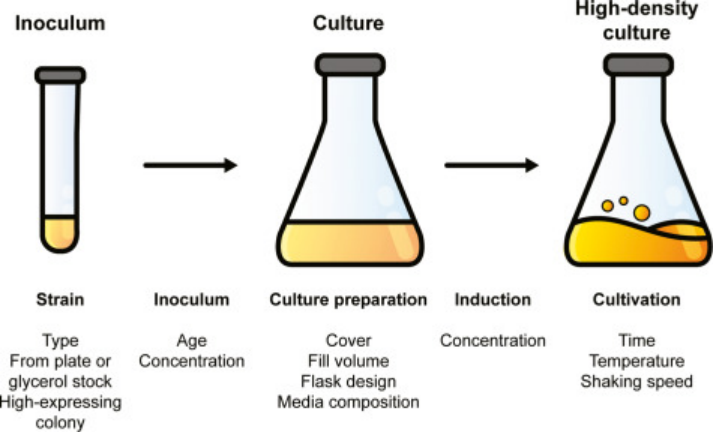 Recombinant protein expression in Escherichia coli (E. coli) remains a foundational technology for producing research grade proteins in biological sciences. As a workhorse microbial platform, E. coli combines wellcharacterized genetics, rapid growth, and robust molecular tools to enable high yields of target proteins for biochemical, structural, and functional studies.
▌Why E. coli Is Widely Used for Recombinant Expression
E. coli is a Gram negative, facultative anaerobe that has been studied and manipulated extensively for decades. Its biology is extremely well understood, and an abundance of molecular biology tools and host strains are available to researchers. The simplicity of culturing E. coli, its short doubling time, and the availability of plasmid expression systems make it ideal for generating milligram to gram quantities of recombinant proteins. E. coli expression is particularly suitable for proteins that do not require complex posttranslational modifications such as glycosylation.
At its core, recombinant protein expression in E. coli requires the introduction of a DNA construct encoding the protein of interest into the bacterial host. This construct carries regulatory elements that drive transcription of the foreign gene and often includes affinity tags that facilitate downstream purification and detection.
▌Expression Strains and Host Systems
A variety of E. coli strains have been engineered to support recombinant protein expression. Among these, BL21(DE3) expression strain derivatives are among the most widely used. BL21(DE3) and related strains are deficient in certain proteases, reducing the degradation of expressed proteins, and harbor the T7 RNA polymerase gene under control of an inducible promoter. This allows robust transcription of recombinant genes placed under a T7 promoter on plasmid vectors.
Alternative strains supplement rare tRNAs, improve disulfide bond formation, or help express toxic proteins. Careful selection of the host strain is a core consideration in constructing a reliable expression system, as different proteins may require specific cellular environments to accumulate in soluble form.
▌Expression Vectors and Regulatory Elements
Plasmid expression vectors are the backbone of recombinant protein expression in E. coli. These vectors combine several elements:
• A promoter to drive transcription of the encoded gene. The phage T7 promoter is a highstrength driver widely used in conjunction with BL21(DE3) strain systems.
• A ribosome binding site (RBS) that promotes efficient translation initiation.
• A multiple cloning site for inserting the gene of interest.
• An antibiotic resistance marker for selection of transformed host cells.
Common promoters also include lac based and tac variants for controlled induction of expression. Regulatory design ensures that basal (uninduced) expression remains low, protecting cells from toxicity associated with unwanted expression prior to induction.
▌Induction of Expression
Once E. coli cells carrying an expression plasmid reach an appropriate growth phase, expression of the target protein is triggered by induction. A chemical inducer such as IPTG induction (Isopropyl β-D-1-thiogalactopyranoside) is added to the culture to inactivate the lac repressor and allow transcription from promoters under lac control. IPTG is non-metabolizable, enabling sustained induction of the expression system.
Proper timing and inducer concentration are important variables that influence expression yield and solubility. Inducer levels can affect the rate of protein synthesis and the metabolic load on the host bacteria, often influencing whether the protein accumulates primarily in the soluble fraction or in aggregated inclusion bodies.
▌Fusion Tags and Affinity Purification
Researchers commonly append affinity tags to the N- or C-terminus of recombinant proteins to simplify purification:
His-tags (typically six histidine residues) enable purification by His-tag protein purification through immobilized metal affinity techniques. His-tagged proteins bind to metal ions (such as Ni²-) immobilized on chromatography resins.
Additional fusion partners such as MBP (maltose-binding protein) or GST (glutathione S-transferase) provide enhanced solubility and enable corresponding affinity chromatography workflows.
Affinity chromatography using Ni-NTA resin (nickel-nitrilotriacetic acid) is one of the most widely used approaches to isolate His-tagged recombinant proteins from complex mixtures after cell lysis. The Ni²- ions coordinated on the resin capture the histidine residues, allowing unbound proteins to be washed away. Proteins are eluted under conditions that disrupt the metalhistidine interaction.
▌Workflow Summary
Although varied in details depending on the protein of interest, a typical E. coli recombinant protein expression workflow includes:
•Construct Design: Cloning the coding sequence into an expression vector with an appropriate promoter and affinity tag.
•Transformation: Introducing the plasmid into an E. coli host strain via chemical or electroporation methods.
•Culture Growth: Growing transformed cells to midlog phase to achieve high cell density prior to induction.
•Induction: Adding IPTG or another inducer to activate transcription of the recombinant gene.
•Expression: Allowing time for protein production as the culture continues to grow.
•Harvest and Lysis: Collecting the cells and lysing them to release the protein.
•Affinity Purification: Using chromatography methods such as NiNTA resin to capture the affinitytagged protein.
•Verification: Assessing yield and purity by SDSPAGE, Western blot, or other analytical methods.
This pipeline provides a standardized basis for producing a wide range of recombinant proteins for laboratory research, structural biology, and biochemical assays.
▌Technical Considerations and Practical Notes
•Solubility: Expression systems must balance high yield against protein solubility. Insoluble proteins often accumulate in inclusion bodies. Techniques such as fusion tags or modified growth conditions (lower temperatures during induction) are common strategies to increase soluble expression.
•Proteolytic Stability: Host strains lacking proteases reduce degradation of recombinant proteins during expression and purification.
•Scale: E. coli systems are amenable to scaling from small research batches to larger preparative volumes by maintaining similar culture and induction regimes.
Key Reagents and Systems in E. coli Expression Services (SEO Focus)
As part of standard proteomics and reagent services, the following components and tools are commonly used to support recombinant protein production in E. coli:BL21(DE3) expression strain; pET expression vectors; His-tag protein purification; Ni-NTA resin; IPTG induction
These reagents are integral to many workflows and serve as starting points for generating recombinant proteins with high reproducibility and compatibility with downstream assays.
Recombinant protein expression in E. coli continues to be a reliable and cost-effective method for producing diverse proteins for laboratory research. By leveraging well-established host strains, expression vectors, and affinity purification systems, researchers can generate proteins with high specificity and consistent quality. Understanding the technical basis of each component in the expression pipeline allows scientists to tailor their workflows to meet experimental and production needs without delving into clinical applications or process optimization strategies.
▌Selected References
1.New tools for recombinant protein production in Escherichia coli. Crit. Rev. Biotechnol. 38, 317–332 (2019).
2.Recombinant protein expression in Escherichia coli: advances and challenges. Front. Microbiol. 12, 682001 (2021).
3.Recent Advances in Recombinant Protein Production in E. coli. Microb. Cell Factories 24, 109 (2025).
4.Additivities for Soluble Recombinant Protein Expression in Escherichia coli. Fermentation 10, 120 (2023).
5.Expression and Purification of Recombinant Proteins in Escherichia coli with His6 or Dual His6MBP Tag. Protein Expr. Purif. 110, 1–8 (2017).