
 +86-15801534258
 info@nebulabio.cn
+86-15801534258
info@nebulabio.cn
info@nebulabio.cn
+86-15801534258
info@nebulabio.cn
From the perspectives of molecular genetics and cell biology, this article explains the key mechanisms that enable long-term expression of an exogenous expression unit in stable cell line platforms. It focuses on how expression cassettes integrate into host chromosomes and how position effects shape transcriptional accessibility, how DHFR- and GS-based metabolic selection systems constrain copy architecture and expression burden, how epigenetic states influence long-term transcriptional persistence, and how proteostasis limitations under high expression link to product consistency. Common characterization metrics are referenced to clarify interpretation pathways for clone-to-clone variation.
The technical objective of a stable cell line platform is to maintain an exogenous expression unit as a heritable genomic configuration within a passagable cell population while preserving relatively consistent transcriptional activity and product features across multiple passages and culture batches. Unlike transient transfection—where plasmid DNA supports short-lived expression—stable expression is jointly determined by three categories of factors: (i) integration architecture, which governs chromatin accessibility and copy organization; (ii) selection pressure, which shapes retention and amplification tendencies of the expression unit in the population; and (iii) chromatin state, which determines whether transcriptional activity attenuates during extended passaging.
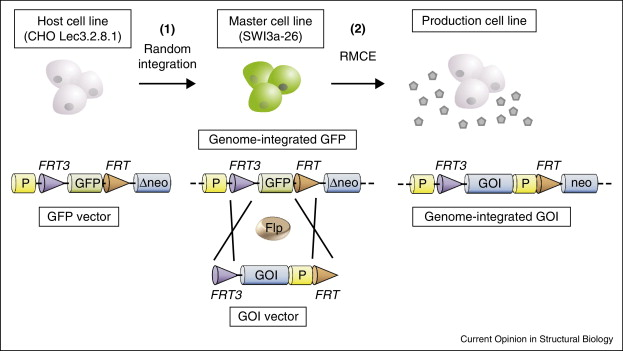
After an expression vector enters the nucleus, stable integration typically involves endogenous DNA damage repair pathways, with non-homologous end joining (NHEJ) being a common route. In this context, the cell recognizes introduced DNA ends as repair substrates and ligates them into chromosomal DNA, creating a covalently integrated expression cassette. Because such integration events are generally non–site-specific, the chromatin environment at the integration locus strongly influences transcriptional accessibility—commonly referred to as a position effect.
When integration occurs in heterochromatic regions, promoters and enhancers are more likely to be exposed to repressive chromatin modifications, resulting in reduced transcriptional activity and increased susceptibility to silencing during passaging. Conversely, integration into more open chromatin regions is typically associated with greater access for transcription-related factors and more sustained activity, yielding more favorable expression levels and stability profiles. In research analysis, position effects are operationally reflected as clone-to-clone variability: the same construct can exhibit distinct expression magnitudes and distinct attenuation trajectories across clones. Accordingly, interpretation is strengthened when copy architecture measurements (e.g., qPCR-based estimates of copy number or cassette abundance) are evaluated alongside transcriptional and protein-level measurements, rather than attributing differences to construct design alone.
Stable cell line platforms often use metabolic selection systems to couple “presence of the expression unit” with “cell survival,” thereby conferring a selective advantage to cells that retain and express the desired construct. DHFR- and GS-based strategies share the principle that under defined nutrient or metabolic constraints, cells must express a selectable marker–associated enzymatic activity to survive. This coupling increases the probability that the expression unit is retained in the population and, under certain conditions, can be associated with copy amplification phenomena.
A critical point is that higher copy number does not necessarily translate linearly into higher product output. While amplification can increase mRNA supply, it also increases the burden on translation, folding, assembly, and secretion pathways, thereby affecting cell physiology and potentially shifting the distribution of product-related heterogeneity. For that reason, platform evaluation is typically more informative when it considers both expression flux and processing-capacity matching. In mammalian expression systems such as CHO cells or HEK293 cells, a high-producing phenotype is more accurately described as a relatively sustainable balance between exogenous expression throughput and host processing capacity, rather than an outcome determined solely by selection intensity or copy number.
Expression attenuation during continuous passaging is frequently linked to epigenetic regulation. After integration, local DNA methylation, histone modification changes, and chromatin compaction can reduce promoter accessibility and progressively decrease transcriptional activity. Importantly, these functional changes can occur even when copy architecture remains largely unchanged, making it necessary to distinguish structural presence of the cassette from functional accessibility of its regulatory regions.
To reduce silencing risk, expression constructs may incorporate cis-acting elements that favor maintenance of open chromatin configurations (e.g., UCOE- or MAR-type elements). The mechanistic objective is to preserve promoter accessibility and the probability of transcription initiation over long-term culture, increasing the likelihood that expression behavior remains reproducible across passages. From an assessment standpoint, stability judgments are better supported by comparisons after multiple passages under defined conditions rather than by short-term expression maxima. For conclusions that are more readily verifiable, it is useful to evaluate copy-related information (e.g., qPCR), transcription-related measures, and protein-level outcomes in parallel to avoid over-attribution based on a single measurement layer.
Under high expression, cellular proteostasis faces increased load, and endoplasmic reticulum folding, assembly, and secretion capacity can become limiting. When proteostasis is perturbed, product-level changes may be observed as shifts in molecular population distributions, such as increases in aggregation-associated fractions or altered fragmentation patterns. Therefore, stable cell line evaluation should treat high expression and product consistency as parallel objectives; otherwise, subsequent work is more likely to encounter batch- or passage-dependent drift in product properties.
In research settings, SDS-PAGE is commonly used to assess integrity and principal molecular-weight features, while SEC is used to evaluate solution-state distributions and aggregation-associated fractions. When relevant, additional characterization can be used to assess modification-related distributions. To ensure that clone comparisons remain interpretable, sample handling conditions should be standardized so that measured differences primarily reflect biological variation rather than differences introduced during pre-analytical processing. Flow cytometry may be used for population-level phenotyping or single-cell derivation workflows, but conclusions regarding product consistency should be anchored in reproducible protein characterization metrics.
The core mechanisms of stable cell line platforms can be summarized as three determinant categories. First, genomic integration via pathways such as NHEJ establishes integration architecture, and position effects at the integration locus drive transcriptional accessibility and clone-to-clone variability. Second, DHFR/GS selection systems impose metabolic constraints that increase retention probability of the expression unit and can, under certain conditions, influence copy architecture and expression burden. Third, epigenetic states shape long-term transcriptional persistence and modulate silencing risk during passaging. Incorporating genetic-layer metrics such as qPCR together with protein characterization metrics strengthens mechanistic interpretation of clonal stability and supports clearer evaluation of product consistency in stable expression platforms.
| For more information, please contact us at info@nebulabio.cn or +86-15801534258. |