
 +86-15801534258
 info@nebulabio.cn
+86-15801534258
info@nebulabio.cn
info@nebulabio.cn
+86-15801534258
info@nebulabio.cn
At the microscopic level of recombinant protein research, bacterial expression systems represent not only the earliest platforms to be systematically harnessed in biotechnology, but also the most direct and analytically tractable experimental models for understanding the central dogma of molecular biology. Although prokaryotic cells lack the complex post-translational modification machinery of higher organisms, Escherichia coli has become the dominant expression host due to its well-defined genetic background, rapid growth kinetics, and exceptional tolerance for exogenous DNA.
From the perspectives of structural biology and biophysics, the technical essence of bacterial expression systems is manifested across three interconnected layers: transcriptional initiation and regulatory switching, ribosome-driven translational kinetics, and the folding or aggregation behavior of nascent polypeptides within a crowded cytoplasmic environment.
Transcriptional Control Logic of the T7 RNA Polymerase System
In contemporary research practice, the pET expression system based on bacteriophage T7 RNA polymerase has become the standard paradigm for bacterial protein expression. The foundation of this system lies in the genetic engineering of host strains such as BL21(DE3), whose chromosome contains an integrated λDE3 prophage region encoding T7 RNA polymerase under the control of the lacUV5 promoter.
Under uninduced conditions, the LacI repressor forms a tetramer that binds tightly to the lac operator sequence, preventing host RNA polymerase from transcribing the T7 RNA polymerase gene. Upon addition of the allosteric inducer isopropyl-β-D-thiogalactopyranoside (IPTG), LacI undergoes a conformational change and dissociates from DNA, allowing transcription of T7 RNA polymerase to proceed.
Once synthesized, T7 RNA polymerase exclusively recognizes T7 promoter sequences located on the expression plasmid and transcribes target genes at rates significantly exceeding those of the host polymerase. This orthogonal transcriptional architecture effectively redirects cellular nucleotide pools and metabolic resources toward the expression of the recombinant gene. To further suppress basal expression, some host strains or vectors incorporate T7 lysozyme, which directly inhibits T7 RNA polymerase activity under non-inducing conditions, thereby maintaining stringent repression for potentially toxic proteins.
Translational Kinetics and Codon Usage Bias
Following robust transcription, translation initiation depends on base pairing between the Shine–Dalgarno sequence and the 3′ end of 16S rRNA. However, the principal kinetic constraints of protein synthesis typically arise during translational elongation, where codon usage bias plays a critical role.
Although the genetic code is degenerate, synonymous codons are not used with equal frequency in E. coli. Codon preference strongly correlates with intracellular tRNA abundance. When heterologous genes contain a high proportion of rare codons, ribosomes may pause or stall during elongation, disrupting translational continuity. Such kinetic perturbations can reduce overall protein yield and increase the likelihood of premature termination, mistranslation, or frameshifting.
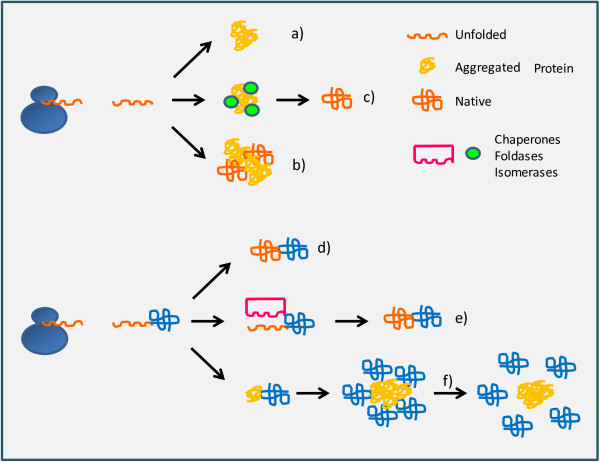
At the molecular level, uneven elongation rates influence co-translational folding events occurring within and immediately beyond the ribosomal exit tunnel. Translational pauses may expose partially synthesized domains to the cytoplasmic environment before proper folding is achieved, thereby increasing susceptibility to misfolding and aggregation.
Reducing Cytoplasmic Environment and the Thermodynamics of Inclusion Body Formation
The bacterial cytoplasm is maintained in a strongly reducing redox state, regulated primarily by the thioredoxin and glutathione systems. This environment inherently disfavors disulfide bond formation, rendering proteins rich in cysteine residues particularly prone to incorrect folding.
From a thermodynamic perspective, protein folding represents an entropy-reducing process driven largely by hydrophobic interactions. When the rate of protein synthesis exceeds the folding capacity of molecular chaperone systems—such as GroEL/GroES or DnaK/DnaJ—exposed hydrophobic regions preferentially engage in intermolecular interactions. This leads to the formation of highly ordered but non-native aggregates known as inclusion bodies.
Contrary to being amorphous precipitates, inclusion bodies often exhibit amyloid-like β-sheet structures, reflecting a low-energy aggregation state. While inclusion body formation complicates direct recovery of biologically active protein, it also provides a mechanism for high-purity sequestration of target proteins while protecting them from proteolytic degradation.
Oxidative Folding in the Periplasmic Compartment
To overcome the limitations imposed by the reducing cytoplasm, E. coli offers a distinct oxidative subcellular compartment: the periplasmic space, located between the inner and outer membranes. This compartment contains disulfide bond–forming and isomerizing enzymes such as DsbA and DsbC, creating an environment conducive to oxidative protein folding.
Targeting proteins to the periplasm requires an N-terminal signal peptide and proceeds through two principal translocation pathways. The Sec pathway transports proteins in an unfolded state through the SecYEG translocon, with cytosolic chaperones maintaining an export-competent conformation. In contrast, the Tat (twin-arginine translocation) pathway enables the transport of fully folded proteins, often containing cofactors, across the inner membrane using the proton motive force.
This compartmentalization strategy allows bacterial systems to partially accommodate structurally complex proteins, including antibody fragments and disulfide-bond-dependent domains, albeit typically at lower yields than cytoplasmic expression.
Biophysical Roles of Fusion Tags
In bacterial expression systems, fusion tags serve functions beyond facilitating downstream purification. Highly soluble tags can act as nucleation centers, promoting proper folding of the fused target protein via intramolecular chaperone effects. By sterically shielding hydrophobic patches, fusion partners reshape the energy landscape of the nascent polypeptide, reducing aggregation propensity and altering folding trajectories within the cytoplasm.
Conclusion
In summary, bacterial expression systems constitute a finely tuned molecular network integrating transcriptional switching, translational rate control, redox environment regulation, and membrane-mediated protein trafficking. A detailed understanding of this prokaryotic “expression chassis” provides the theoretical foundation for protein engineering, structural studies, and synthetic biology design.