
 +86-15801534258
 info@nebulabio.cn
+86-15801534258
info@nebulabio.cn
info@nebulabio.cn
+86-15801534258
info@nebulabio.cn
Recombinant Proteins for ALS Research
Amyotrophic lateral sclerosis (ALS) is a progressive neurodegenerative disorder characterized by the degeneration of upper and lower motor neurons. The disease involves multiple cellular and molecular processes, including abnormal RNA metabolism, impaired protein homeostasis, pathological protein aggregation, mitochondrial dysfunction, oxidative stress, defects in axonal transport, and neuroinflammatory responses.
ALS is molecularly heterogeneous. Some cases are associated with defined genetic alterations, whereas many sporadic cases cannot be attributed to a single genetic cause. Despite differences in the initiating events, several pathological mechanisms converge on common cellular processes, particularly abnormalities in RNA-binding proteins, protein quality control, organelle homeostasis, and motor neuron integrity.
For this reason, recombinant proteins for ALS research are not limited to a single target. Instead, they provide experimental components for studying disease-associated proteins, abnormal protein states, protein interactions, aggregation, cellular signaling, and neuronal injury.
Major Molecular Mechanisms in ALS
The molecular pathology of ALS can be broadly viewed as an interconnected network:
Genetic or molecular abnormalities → altered RNA and protein homeostasis → abnormal protein accumulation → cellular and organelle dysfunction → neuroinflammation → motor neuron and axonal injury
These processes do not necessarily occur as a simple linear pathway. Abnormal proteins can interfere with protein degradation systems, while impaired autophagy and proteasomal activity can further promote intracellular accumulation. Mitochondrial dysfunction and oxidative stress can also influence protein homeostasis and neuronal metabolism.
This interconnected mechanism is important when selecting ALS-related recombinant proteins for research. A core disease-associated protein may be investigated together with downstream proteins involved in autophagy, mitochondrial quality control, inflammation, or neuronal damage.
1. SOD1: A Classic ALS Disease-Associated Protein
SOD1 (Superoxide Dismutase 1) is one of the best-established proteins in ALS research. Mutations in the SOD1 gene are associated with familial ALS, making SOD1 an important model for investigating the molecular basis of motor neuron degeneration.
SOD1 normally participates in cellular antioxidant defense. In ALS-associated SOD1 variants, research has focused on altered protein conformation, misfolding, aggregation, and disruption of cellular protein homeostasis rather than simply loss of enzymatic activity.
Common research models include wild-type SOD1 and ALS-associated variants such as SOD1 A4V, SOD1 G93A, and SOD1 G85R.
From a recombinant protein perspective, SOD1 is particularly useful for studying protein structure, protein-protein interactions, aggregation behavior, and mutation-associated changes in protein properties.
The major mechanistic relationship can be summarized as:
SOD1 mutation → altered protein conformation → protein homeostasis abnormalities → cellular stress and neuronal dysfunction
SOD1 therefore represents an important connection between ALS genetics and protein pathology.
2. TDP-43: A Central RNA-Binding Protein in ALS Pathology
TDP-43 (TAR DNA-Binding Protein 43), encoded by the TARDBP gene, is one of the most important pathological proteins studied in ALS.
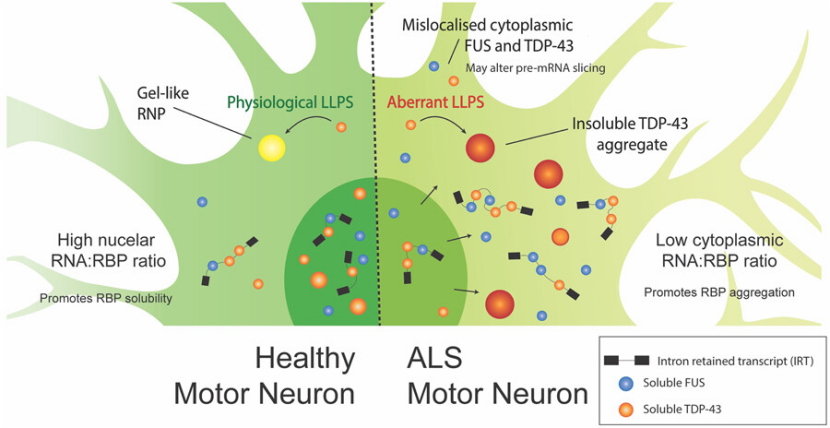
Under physiological conditions, TDP-43 is predominantly localized in the nucleus and participates in RNA processing, splicing, transport, and stability. In ALS-associated pathology, TDP-43 can undergo abnormal redistribution from the nucleus to the cytoplasm and form pathological aggregates.
This creates an important connection between two major ALS mechanisms:
RNA metabolism dysfunction ↔ protein homeostasis dysfunction
Pathological TDP-43 can exhibit abnormal phosphorylation, ubiquitination, cleavage, and aggregation. These molecular changes have made TDP-43 an important experimental target for studying protein aggregation and pathological protein states. The ALS Association notes that TDP-43 dysfunction is associated with the vast majority of ALS pathology.
Recombinant TDP-43 can therefore be used in research involving protein structure, aggregation, RNA binding, molecular interactions, and recognition of disease-associated protein forms.
Compared with SOD1, TDP-43 provides a particularly useful model for investigating the relationship between RNA-binding protein dysfunction and abnormal protein aggregation.
3. FUS: Linking RNA Metabolism and Protein Condensation
FUS (FUS RNA-Binding Protein) is another important ALS-associated RNA-binding protein.
FUS participates in RNA processing and transport and is associated with cellular stress responses, nucleocytoplasmic transport, stress granules, and biomolecular condensation. Certain FUS variants are associated with familial ALS.
Abnormal FUS localization and aggregation have therefore become important areas of ALS research. FUS also provides a useful model for examining the relationship between RNA metabolism and abnormal protein condensation.
When FUS is studied alongside TDP-43, researchers can examine different aspects of RNA-binding protein dysfunction, including altered localization, RNA processing, stress granule dynamics, and protein aggregation.
In this context, FUS recombinant protein is particularly relevant to research involving RNA-binding activity, protein-protein interactions, protein aggregation, and biomolecular condensation.
4. C9orf72: Repeat Expansion and Dipeptide Repeat Proteins
C9orf72 represents a distinct molecular mechanism in ALS research. A hexanucleotide repeat expansion in the C9orf72 gene is a major genetic cause associated with ALS and frontotemporal dementia.
Unlike SOD1-associated disease, the C9orf72 mechanism is closely linked to repeat RNA and the production of dipeptide repeat proteins (DPRs). Important DPR species include Poly-GA, Poly-GR, Poly-PR, and Poly-GP.
These abnormal proteins have been studied in relation to protein aggregation, RNA metabolism, nucleocytoplasmic transport, and cellular protein homeostasis.
The C9orf72 system can therefore be considered as:
Repeat expansion → abnormal repeat RNA and DPR production → altered cellular homeostasis → neuronal dysfunction
For recombinant protein research, this distinction is important. C9orf72-related studies may involve not only the C9orf72 protein itself, but also specific DPR proteins as experimental targets.
Protein Homeostasis and Autophagy
Abnormal protein accumulation is closely connected to the cellular systems responsible for protein quality control.
Neurons continuously synthesize, fold, transport, and degrade proteins. Misfolded or damaged proteins are normally removed through coordinated mechanisms involving molecular chaperones, the ubiquitin-proteasome system, and autophagy.
Several ALS-associated proteins participate in these pathways. TBK1, OPTN, VCP, and SQSTM1/p62, for example, are linked to protein degradation, autophagy, or cellular quality-control mechanisms.
This provides an important mechanistic connection between core ALS proteins and downstream cellular pathways:
Abnormal protein formation → recognition and processing → autophagy/proteasomal degradation → accumulation when clearance is insufficient
Recombinant proteins involved in these pathways can therefore be used alongside SOD1, TDP-43, FUS, or C9orf72-related proteins to investigate protein homeostasis at the molecular level.
Mitochondrial Dysfunction and Oxidative Stress
Mitochondrial dysfunction is another important component of ALS research. Motor neurons have high metabolic requirements, making mitochondrial energy production and quality control particularly relevant to neuronal function.
ALS-related studies have examined mitochondrial morphology, dynamics, energy metabolism, oxidative stress, and mitophagy. Proteins such as PINK1 and Parkin participate in mitochondrial quality control, while MFN2, OPA1, and DRP1 regulate mitochondrial fusion and fission.
SOD1 is also relevant to this area because of its relationship with oxidative stress and cellular redox homeostasis.
These pathways should not be considered isolated from protein aggregation. Changes in mitochondrial function can influence cellular stress and protein homeostasis, while abnormal protein accumulation can further interfere with organelle function.
Neuroinflammation and Motor Neuron Injury
ALS pathology also involves interactions between motor neurons and glial cells. Microglia and astrocytes can undergo disease-associated changes and participate in inflammatory signaling within the nervous system.
TREM2, CSF1R, and NLRP3 are among the proteins studied in relation to microglial signaling and inflammatory responses, while cytokines such as TNF-α, IL-1β, and IL-6 can be used to investigate inflammatory signaling.
At the neuronal level, defects in axonal transport and cytoskeletal organization may further affect motor neuron integrity. Proteins involved in axonal transport and the neuronal cytoskeleton therefore represent downstream research targets rather than primary ALS disease proteins.
This distinction is useful when building an ALS recombinant protein research panel: core disease-associated proteins can be combined with pathway proteins to investigate how molecular abnormalities translate into neuronal dysfunction.
NfL: A Key Protein for Axonal Injury Research
Neurofilament light chain (NfL), encoded by NEFL, is an important structural component of neuronal cytoskeletons and one of the most extensively studied neurofilament proteins in ALS research.
NfL is different from SOD1, TDP-43, FUS, and C9orf72 because it is not considered a primary ALS disease-causing protein. Instead, it is closely associated with neuronal and axonal injury.
When neurons undergo degeneration, neurofilament proteins can be released into extracellular fluids. NfL is therefore widely studied in ALS research as a marker associated with neuroaxonal damage. The ALS Association identifies NfL as the most extensively studied neurofilament and notes its elevation in ALS.
NfL and pNfH are also among the neurofilament proteins investigated as biological markers in ALS research.
From a recombinant protein perspective, NfL occupies a different position from the core disease-associated proteins: SOD1, TDP-43, FUS, and C9orf72 are primarily used to investigate disease mechanisms, whereas NfL is more closely related to neuronal and axonal injury.