
 +86-15801534258
 info@nebulabio.cn
+86-15801534258
info@nebulabio.cn
info@nebulabio.cn
+86-15801534258
info@nebulabio.cn

From the perspectives of biophysical chemistry and structural biology, this article systematically examines the molecular strategies used to introduce functional probes, stable isotopes, or reactive groups into protein structures. Emphasis is placed on the chemical reactivity and spatial accessibility of lysine and cysteine residues, the kinetic and selectivity principles underlying NHS ester and maleimide conjugation, and the unique advantages of bioorthogonal chemistry—such as click reactions—in complex biological environments. Enzymatic labeling systems and non-canonical amino acid incorporation are further discussed as routes toward atom-level site-specific modification, providing a theoretical framework for precise protein functional analysis and structural interrogation.
In the intersection of structural biology and chemical biology, protein labeling is not a simple act of tag attachment but a form of nanoscale chemical engineering. The central challenge lies in introducing externally detectable or functional moieties into proteins without perturbing their native fold, obstructing active sites, or inducing non-specific aggregation. Achieving this balance requires a systematic understanding of amino-acid-level reactivity, solvent accessibility, and the kinetic boundaries of conjugation reactions within folded macromolecules.
Lysine and cysteine chemistry defines the practical limits of classical bioconjugation
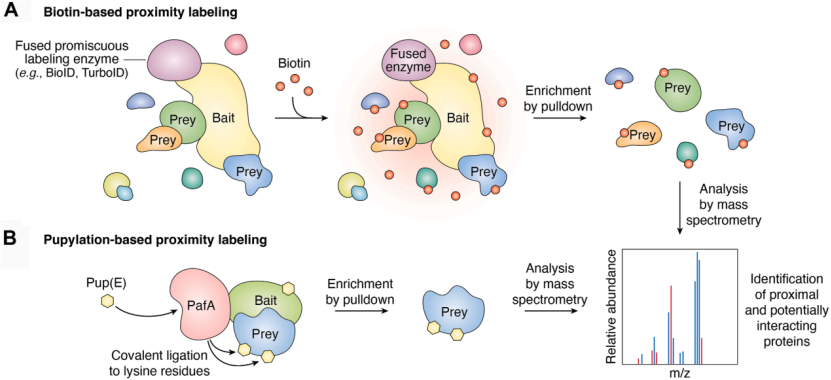
The most widely used protein labeling strategies rely on the intrinsic nucleophilicity of amino acid side chains, with lysine and cysteine serving as the dominant chemical entry points. Lysine labeling is typically based on N-hydroxysuccinimide (NHS) ester chemistry. Under mildly basic conditions, the ε-amino group of lysine becomes deprotonated and acts as a nucleophile, attacking the carbonyl carbon of the NHS ester to form a stable amide bond. This reaction proceeds efficiently in aqueous buffers and is therefore broadly adopted for fluorescent labeling and biotinylation.
However, lysine-based labeling is inherently stochastic. Most proteins present multiple solvent-exposed lysine residues, each with similar reactivity but distinct structural contexts. As a result, labeling generates heterogeneous populations in which the number and position of modifications vary from molecule to molecule. While acceptable for bulk detection, this heterogeneity imposes fundamental limitations on quantitative kinetic studies, distance-sensitive measurements such as FRET, and high-resolution structural interpretation.
Cysteine labeling offers a higher degree of positional control. Thiol groups react readily with maleimides or iodoacetamides via Michael addition or nucleophilic substitution, forming stable thioether linkages. Because free cysteines are relatively rare in many proteins and often buried within hydrophobic cores, site-directed mutagenesis can be used to introduce a single solvent-accessible cysteine, enabling near-stoichiometric, site-specific labeling.
This strategy, however, is chemically delicate. Reaction selectivity is strongly pH-dependent, and competing nucleophiles emerge at higher pH values. Oxidation of thiols or unintended disulfide formation can further complicate reaction outcomes, underscoring the narrow kinetic window in which cysteine chemistry remains both efficient and selective.
Enzymatic labeling achieves true site specificity through biological catalysis
To overcome the intrinsic randomness of chemical conjugation, enzymatic labeling systems exploit the extraordinary substrate specificity of biological catalysts. A canonical example is the biotin ligase BirA, which recognizes a defined peptide sequence (AviTag) and catalyzes ATP-dependent covalent attachment of biotin to a single lysine residue within that motif. Because the enzyme ignores all other lysines in the protein, the resulting product is chemically homogeneous.
The biotin–streptavidin interaction, among the strongest known non-covalent interactions in biology, provides an exceptionally robust anchoring mechanism. This property has made BirA-based labeling indispensable for protein immobilization, single-molecule manipulation, and biosensor assembly, where positional consistency and mechanical stability are critical.
Related enzymatic approaches rely on transpeptidases such as sortase A, which recognize short consensus motifs and catalyze controlled peptide bond rearrangements. These systems are particularly well suited for terminal labeling, allowing functional groups to be appended to protein N- or C-termini without perturbing folded domains. Collectively, enzyme-mediated strategies shift protein labeling from statistical chemistry toward deterministic molecular engineering.
Bioorthogonal chemistry enables selective reactions in complex biological environments
When labeling must occur in cell lysates or even living cells, classical conjugation chemistry becomes impractical due to extensive side reactions. Bioorthogonal chemistry addresses this limitation by employing functional groups that are chemically inert toward native biomolecules yet react rapidly and selectively with each other.
Through genetic code expansion, non-canonical amino acids bearing azides, strained alkynes, or trans-cyclooctenes can be incorporated at defined positions within proteins. These moieties remain silent under physiological conditions until paired with a complementary reactant. Among the most powerful examples is the inverse electron-demand Diels–Alder reaction between tetrazines and strained alkenes, which proceeds with exceptionally high rate constants and without the need for metal catalysts.
The ultrafast kinetics of these reactions allow efficient labeling at low probe concentrations, minimizing background and cellular perturbation. As a result, bioorthogonal chemistry has become a cornerstone for real-time tracking of protein dynamics, pulse-chase experiments, and spatially resolved labeling in live systems.
Isotope substitution extends protein labeling to the atomic scale
In structural biology, labeling often involves atomic replacement rather than functional group addition. For X-ray crystallography, substitution of methionine with selenomethionine introduces selenium atoms that provide strong anomalous scattering signals, enabling experimental phase determination. Because selenium closely mimics sulfur in size and bonding geometry, this substitution typically preserves overall protein folding.
In nuclear magnetic resonance spectroscopy, incorporation of stable isotopes such as 15N, 13C, and 2H is essential for resolving spectra of large proteins. Uniform or selective isotope labeling reduces spectral overlap and enhances sensitivity, while specialized strategies such as methyl-specific labeling highlight dynamic regions within otherwise intractable macromolecules. These approaches transform isotopic labeling into a powerful probe of both structure and motion.
Conclusion
Across chemical conjugation, enzymatic tagging, bioorthogonal reactions, and isotope substitution, a unifying principle governs effective protein labeling: the modification must introduce measurable contrast while minimally altering the protein’s energy landscape. Excessive perturbation compromises biological relevance, whereas insufficient signal undermines interpretability.
Protein labeling therefore represents not a single technique but an integrated molecular toolbox, bridging organic chemistry, enzymology, and structural physics. Mastery of its underlying mechanisms enables proteins to be transformed from invisible molecular entities into precisely traceable, quantifiable, and structurally resolvable systems—unlocking deeper insight into biological function at molecular resolution.
| For more information, please contact us at info@nebulabio.cn or +86-15801534258. |