
 +86-15801534258
 info@nebulabio.cn
+86-15801534258
info@nebulabio.cn
info@nebulabio.cn
+86-15801534258
info@nebulabio.cn
From the fundamental perspectives of structural biology and protein engineering, this article systematically analyzes the unique biophysical advantages of Small Ubiquitin-like Modifier (SUMO) proteins as fusion tags in recombinant protein production. The discussion focuses on how the compact and highly stable tertiary structure of SUMO exerts an intramolecular chaperone effect during protein folding, how its surface charge distribution suppresses hydrophobic aggregation at the thermodynamic level, and how SUMO-specific proteases such as Ulp1 achieve exceptional cleavage specificity through global conformational recognition. Together, these mechanisms explain why the SUMO system enables reliable generation of recombinant proteins with a native, scarless N-terminus.
In the complex landscape of recombinant protein production, SUMO-tag–based strategies represent far more than a simple affinity handle. SUMO (Small Ubiquitin-like Modifier) is a compact globular protein of approximately 12 kDa with a highly stable tertiary structure. From a structural biology perspective, SUMO functions not only as a purification aid but also as an active modulator of folding pathways when fused to heterologous proteins.
Unlike short linear tags such as His-tag or Flag-tag, SUMO introduces a pre-folded, structurally rigid domain at the N-terminus of the fusion protein. This structural feature allows SUMO to intervene directly in the folding energy landscape of the target protein, mitigating aggregation and promoting productive folding. At the same time, the SUMO system is uniquely distinguished by the availability of highly specific proteases, such as Ulp1, which remove the tag with absolute precision and without leaving extraneous residues. Together, these properties make SUMO fusion technology a powerful and reliable solution for producing soluble, structurally homogeneous recombinant proteins with native N-terminal sequences.
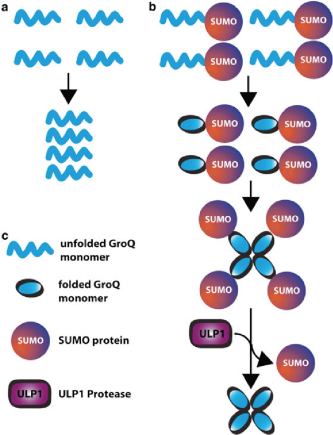
SUMO functions as an intramolecular chaperone that reshapes folding kinetics of fusion proteins
In heterologous expression systems, protein insolubility is often driven by kinetic imbalance rather than intrinsic structural incompatibility. When the rate of polypeptide synthesis exceeds the rate of productive folding, hydrophobic segments of nascent chains remain exposed, increasing the probability of non-specific intermolecular interactions and aggregation.
The defining advantage of SUMO lies in its rapid and autonomous folding behavior. When fused to the N-terminus of a target protein, SUMO typically reaches its native conformation early during translation, forming a compact and highly stable structural core. This folded SUMO domain effectively acts as an intramolecular chaperone, providing a nucleation point that stabilizes the emerging polypeptide chain.
By doing so, SUMO delays access to aggregation-prone folding pathways and increases the likelihood that downstream regions of the fusion protein fold in a controlled, intramolecular manner. In kinetic terms, SUMO shifts the balance away from multi-molecular aggregation toward productive folding, not by passive solubility enhancement but by active modulation of the folding trajectory itself.
Surface charge distribution and hydration effects thermodynamically suppress hydrophobic aggregation
Beyond folding kinetics, SUMO exerts a strong thermodynamic influence on fusion protein solubility through its surface physicochemical properties. SUMO displays a high density of polar and charged residues on its surface, enabling the formation of a robust hydration shell in aqueous environments.
When incompletely folded hydrophobic regions of the target protein are positioned adjacent to the SUMO domain, this highly hydrated surface reduces the probability of hydrophobic patch–to–patch interactions between neighboring molecules. From a free-energy perspective, SUMO effectively raises the energetic barrier for aggregation, rendering intermolecular association less favorable.
This effect is sometimes described as “micelle-like,” although it differs fundamentally from detergent-based solubilization. Rather than directly encapsulating hydrophobic regions, SUMO stabilizes the solvent environment surrounding the fusion protein through its intrinsic structural rigidity and electrostatic surface features. This indirect but robust mechanism explains the broad applicability of SUMO tags across diverse classes of aggregation-prone proteins.
Ulp1 achieves near-absolute cleavage specificity through global conformational recognition
The practical value of any fusion tag ultimately depends on the efficiency and precision with which it can be removed. In this regard, the SUMO system differs fundamentally from conventional protease-based strategies. SUMO-specific proteases such as Ulp1 do not recognize short linear amino-acid motifs. Instead, they rely on recognition of the intact tertiary structure of the SUMO domain.
Ulp1 engages SUMO through extensive surface complementarity, forming a large interaction interface that only assembles correctly when SUMO is properly folded. As a result, cleavage occurs exclusively at the SUMO–target junction and only when the SUMO domain adopts its native conformation. This conformation-dependent recognition mechanism makes off-target cleavage within the target protein statistically negligible.
By contrast, proteases that recognize linear sequences may encounter similar motifs elsewhere in the protein, leading to unintended degradation. The SUMO–Ulp1 system avoids this limitation entirely by using structural validation as a prerequisite for catalysis, thereby achieving an exceptional level of specificity.
Scarless cleavage ensures native N-termini with structural and functional fidelity
For structural biology and functional studies, the integrity of the protein N-terminus is often critical. Even a few extraneous residues introduced during cloning or protease cleavage can disrupt folding, interfere with crystallization, or alter biological activity.
SUMO fusion technology uniquely enables scarless cleavage at the N-terminus. The C-terminus of SUMO ends with a conserved diglycine motif, and Ulp1 cleaves precisely between this motif and the first residue of the target protein. This stereochemically constrained reaction leaves no residual amino acids from the tag.
As a result, the released protein begins exactly at its native N-terminal residue, regardless of its identity (with the exception of proline). This atomic-level fidelity is difficult to achieve with other fusion systems and is particularly valuable for proteins whose N-termini play regulatory or structural roles.
Conclusion
In summary, the SUMO fusion system represents a highly engineered solution that integrates folding control, solubility enhancement, and precise tag removal into a single modular platform. Through its intramolecular chaperone effect, SUMO actively reshapes folding kinetics; through its surface properties, it thermodynamically suppresses aggregation; and through Ulp1-mediated conformational recognition, it enables scarless release of native proteins.
For aggregation-prone targets and N-terminally sensitive proteins, SUMO fusion technology provides a high-confidence pathway from gene sequence to structurally authentic recombinant protein, grounded in well-defined biophysical and structural principles.
| For more information, please contact us at info@nebulabio.cn or +86-15801534258. |