
 +86-15801534258
 info@nebulabio.cn
+86-15801534258
info@nebulabio.cn
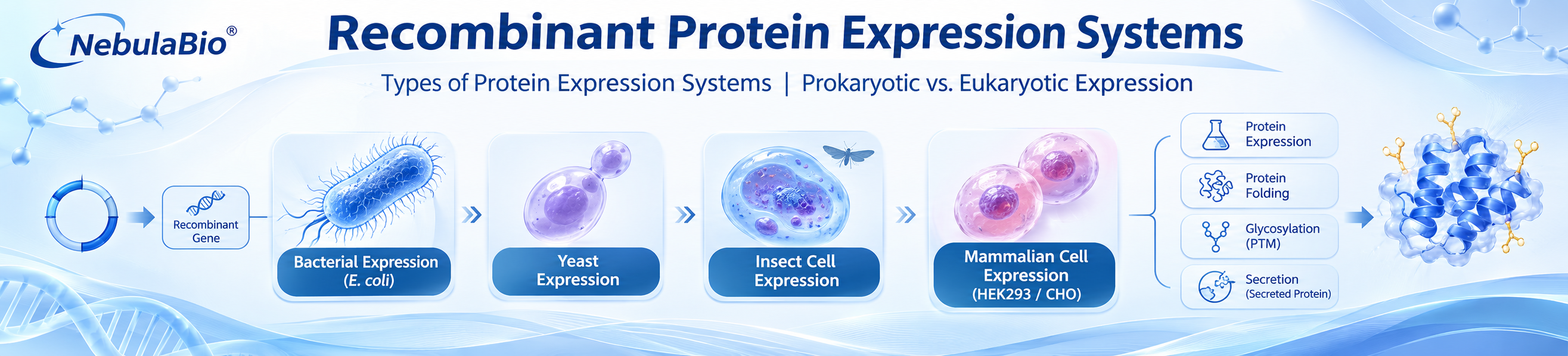
Recombinant protein expression involves the production of a target protein from an introduced gene using a biological expression system. Common recombinant protein expression systems include bacterial, yeast, insect cell, and mammalian cell platforms. These systems differ in their cellular organization, protein folding machinery, post-translational modifications, glycosylation pathways, and protein secretion mechanisms. As a result, recombinant proteins with identical amino acid sequences may exhibit different structural and biochemical properties depending on the expression host.
Fundamentals of Recombinant Protein Expression
Recombinant protein expression relies on the transcription and translation machinery of a host cell. A gene encoding the target protein is transcribed into messenger RNA (mRNA), which is subsequently translated by ribosomes into a polypeptide chain.
Following translation, the nascent polypeptide undergoes folding to acquire its three-dimensional structure. Depending on the protein, additional processing may involve disulfide bond formation, glycosylation, proteolytic cleavage, or assembly with other polypeptide chains. These processes contribute to the formation of mature proteins with specific structural and functional properties.
Recombinant proteins may be expressed intracellularly or secreted into the extracellular environment. Intracellular proteins remain within the cytoplasm or specific cellular compartments, whereas secreted proteins are transported through the host's secretion machinery. The subcellular localization of a recombinant protein is closely associated with its signal peptide, transmembrane regions, and native structural characteristics.
Common Types of Protein Expression Systems
● Bacterial Expression System (E. coli Expression)
Escherichia coli is one of the most widely used hosts for prokaryotic protein expression. Its well-characterized genetics and rapid growth make it suitable for expressing bacterial proteins, enzymes, antigen fragments, and individual protein domains.
Unlike eukaryotic cells, E. coli lacks an endoplasmic reticulum and Golgi apparatus. Conventional E. coli expression strains cannot perform the complex glycosylation processes characteristic of mammalian cells. Consequently, recombinant proteins that depend on glycosylation for structural stability or molecular recognition may differ from their native counterparts.
The reducing environment of the bacterial cytoplasm can also affect disulfide bond formation. Proteins containing multiple disulfide bonds may undergo improper folding or aggregation under certain expression conditions.
Bacterially expressed proteins may accumulate in soluble form or as inclusion bodies. Inclusion bodies are insoluble intracellular aggregates composed primarily of recombinant proteins. Their formation is associated with protein folding kinetics, intermolecular interactions, and the physicochemical properties of the expressed polypeptide.
● Yeast Expression System
Yeast expression systems use unicellular eukaryotic organisms, including Saccharomyces cerevisiae and Komagataella phaffii, formerly known as Pichia pastoris.
Yeast cells contain an endoplasmic reticulum, Golgi apparatus, and functional secretory pathway. These cellular structures support protein folding, disulfide bond formation, and certain post-translational modifications.
One distinguishing feature of yeast protein expression is its glycosylation pattern. Yeast-derived recombinant glycoproteins frequently contain mannose-rich N-linked glycans, and some proteins exhibit extensive glycosylation.
Compared with mammalian-derived proteins, yeast-expressed glycoproteins may differ in glycan composition, apparent molecular weight, solubility, and molecular recognition properties. The extent of these differences depends on the yeast species, expression strain, and target protein.
● Insect Cell Expression System
Insect cell protein expression commonly uses the baculovirus expression vector system (BEVS). Frequently used host cell lines include Sf9, Sf21, and High Five cells.
As eukaryotic hosts, insect cells possess intracellular machinery for protein folding, disulfide bond formation, and post-translational processing. They are used to express viral structural proteins, eukaryotic enzymes, multidomain proteins, and certain multiprotein complexes.
Insect cells can perform N-linked glycosylation, although their glycan-processing pathways differ from those of mammalian cells. Insect cell-derived proteins generally contain simpler N-linked glycan structures, with limited complex glycan processing and terminal sialylation.
These differences may influence the molecular weight, glycan heterogeneity, and biochemical properties of recombinant glycoproteins.
● Mammalian Cell Expression System
Mammalian protein expression systems commonly use human embryonic kidney 293 (HEK293) cells and Chinese hamster ovary (CHO) cells. These hosts are widely used for expressing recombinant antibodies, cytokines, growth factors, receptor extracellular domains, and other eukaryotic proteins.
HEK293 cells are derived from human embryonic kidney cells and possess the cellular machinery required for protein folding, glycosylation, and secretion. CHO cells, derived from Chinese hamster ovary tissue, also support complex protein processing and post-translational modifications.
Both HEK293 and CHO expression systems can generate complex N-linked glycans. However, glycan branching, fucosylation, sialylation, and other glycosylation characteristics may vary between cell lines.
Mammalian cell expression provides a cellular environment capable of many processing events associated with native eukaryotic proteins. Nevertheless, the glycosylation profile and other molecular characteristics of a recombinant protein are not necessarily identical to those of the corresponding native protein.
Prokaryotic vs. Eukaryotic Protein Expression
The primary differences between prokaryotic and eukaryotic protein expression arise from the cellular organization and protein-processing machinery of the expression hosts.
Prokaryotic cells lack a membrane-bound nucleus and conventional intracellular organelles such as the endoplasmic reticulum and Golgi apparatus. Eukaryotic cells contain specialized compartments that support protein folding, modification, intracellular transport, and secretion.
| Feature | Prokaryotic Expression | Eukaryotic Expression |
| Common hosts | E. coli | Yeast, insect cells, mammalian cells |
| Cellular organization | No membrane-bound nucleus or conventional organelles | Contains a nucleus and membrane-bound organelles |
| Protein folding | Prokaryotic folding machinery | Eukaryotic folding and processing machinery |
| Glycosylation | Conventional E. coli systems lack eukaryotic-type glycosylation | Supports glycosylation, with host-dependent glycan structures |
| Disulfide bond formation | Influenced by cellular redox conditions | Supported by specialized environments, including the endoplasmic reticulum |
| Protein secretion | Bacterial secretion pathways | Eukaryotic secretory pathways |
| Common protein types | Bacterial enzymes, antigen fragments, protein domains | Glycoproteins, antibodies, cytokines, receptor proteins |
Eukaryotic expression is not synonymous with mammalian expression. Yeast, insect cells, and mammalian cells are all eukaryotic hosts, but they differ substantially in their glycosylation pathways and protein-processing capabilities.
Effects of Expression Systems on Recombinant Protein Properties
● Protein Folding and Disulfide Bond Formation
Protein conformation is determined by the amino acid sequence and the molecular interactions that stabilize its three-dimensional structure. Hydrophobic interactions, hydrogen bonding, electrostatic interactions, and disulfide bonds contribute to protein folding and structural stability.
Disulfide bonds form through the oxidation of cysteine residues and are particularly important in many secreted proteins, antibodies, and receptor extracellular domains.
Expression hosts differ in their intracellular redox environments, molecular chaperones, and folding-associated enzymes. These differences can affect disulfide bond pairing and the final conformation of recombinant proteins. Incorrect disulfide bond formation may contribute to structural heterogeneity or protein aggregation.
● Glycosylation and Post-Translational Modifications
Post-translational modifications (PTMs) include glycosylation, phosphorylation, acetylation, ubiquitination, and proteolytic processing.
Glycosylation is particularly common among secreted and membrane-associated proteins. N-linked glycosylation typically occurs at asparagine residues within specific sequence motifs, whereas O-linked glycosylation can occur at serine or threonine residues.
Glycans can contribute to protein stability, molecular recognition, solubility, and conformational properties. Because expression hosts differ in their glycosyltransferases and glycan-processing pathways, proteins with identical amino acid sequences may exhibit distinct glycosylation profiles.
Glycosylation can also affect apparent molecular weight. Some mammalian-expressed glycoproteins migrate at higher apparent molecular weights than predicted from their amino acid sequences during SDS-PAGE analysis. Glycan heterogeneity may also produce broader electrophoretic bands.
● Protein Secretion and Subcellular Localization
Secreted proteins commonly contain signal peptides that direct nascent polypeptides into the endoplasmic reticulum. These proteins subsequently undergo intracellular processing and trafficking through the secretory pathway.
Membrane proteins contain one or more transmembrane domains that anchor them within cellular membranes. Their native conformations may depend on membrane lipid composition, protein topology, and intracellular trafficking mechanisms.
Single-pass membrane receptors generally contain extracellular, transmembrane, and intracellular regions. Multipass membrane proteins have more complex membrane topologies, with multiple membrane-spanning segments connected by extracellular and intracellular loops.
For receptor proteins, a soluble extracellular domain differs from the full-length membrane-associated protein in molecular composition and structural constraints. Some receptors also require dimerization or multimeric assembly to maintain their native structural organization.
Expression Characteristics of Different Protein Classes
The molecular characteristics of recombinant proteins vary according to their biological origin, structural organization, and dependence on post-translational processing.
Enzymes: Many bacterial enzymes and proteins that do not require complex post-translational modifications can form functional structures in E. coli. Certain eukaryotic enzymes, however, depend on phosphorylation, glycosylation, cofactor incorporation, or other processing events.
Cytokines and growth factors: These proteins often possess defined tertiary structures, and some require disulfide bonds to maintain conformational stability. Glycosylation patterns and native oligomeric states vary among protein families.
Recombinant antibodies: Full-length immunoglobulin G (IgG) consists of two heavy chains and two light chains. Its molecular organization involves interchain disulfide bonds, subunit assembly, and Fc-region glycosylation. Antibody fragments such as Fab and single-chain variable fragments (scFv) have distinct structural and processing characteristics.
Viral envelope glycoproteins: These proteins frequently contain multiple glycosylation sites and may form dimeric or trimeric assemblies. Glycan distribution, disulfide bond pairing, and oligomerization can influence their conformational properties.
Differences among recombinant protein expression systems are reflected in protein folding, glycosylation, disulfide bond connectivity, and proteolytic processing. Even when recombinant proteins share an identical primary amino acid sequence, their final molecular composition and structural properties may vary according to the expression host.
| For more information, please contact us at info@nebulabio.cn or +86-15801534258. |