
 +86-15801534258
 info@nebulabio.cn
+86-15801534258
info@nebulabio.cn
info@nebulabio.cn
+86-15801534258
info@nebulabio.cn
GPCR stable cell lines are among the most widely used experimental models in cell-based pharmacology, yet they are often oversimplified as cells that “express receptors long term.” This article presents an engineering-oriented perspective on GPCR stable cell lines, emphasizing their role as reproducible signaling systems rather than expression tools. The discussion examines why stability is essential for pharmacological studies, how stable models differ structurally from transient systems, the shared engineering logic underlying GPCR stability, the influence of host cell backgrounds such as HEK293 and CHO, and how multi-level validation using qPCR, Western blot, flow cytometry, and ELISA defines functional consistency across passages.
1. From Expression to Reproducibility: The Central Challenge in GPCR Modeling
In GPCR research, the primary challenge is not whether a receptor can be expressed in cells, but whether receptor-mediated signaling can be measured in a reliable and repeatable manner. Many pharmacological questions—including dose–response relationships, ligand selectivity, signaling bias, and cross-batch comparison—depend fundamentally on temporal consistency.
Transient expression systems are invaluable for early exploration, but their outputs are strongly influenced by transfection efficiency, cellular state, and timing. These dependencies introduce variability that complicates interpretation. GPCR stable cell lines were developed to convert receptor expression from a transient event into an engineered experimental system.
2. Structural Differences Between Stable and Transient GPCR Models
The key distinction between stable and transient GPCR models lies not in signal magnitude, but in predictability. In transient systems, receptor copy number and intracellular distribution change over time, directly affecting functional output.
Stable GPCR cell lines embed receptor expression into the cellular genetic background, allowing it to be maintained during cell division. This shift relocates experimental variability away from the expression system and toward ligand stimulation and pathway biology, making stable models more suitable for reproducible pharmacological analysis.
3. Shared Engineering Logic Underlying GPCR Stable Cell Lines
From an engineering perspective, GPCR stable cell lines are governed by design principles centered on stability rather than on a single technical implementation.
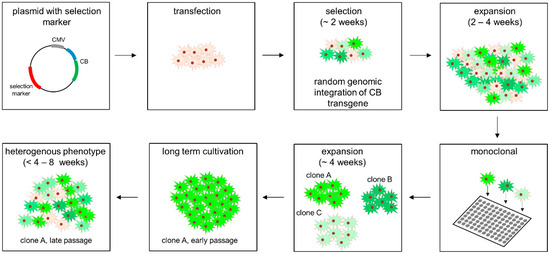
First, stable models must maintain a defined genetic and phenotypic state across passages. Whether receptor expression is achieved via lentivirus-mediated integration or other strategies, the engineered state must resist dilution, silencing, or selective loss.
Second, stable GPCR models emphasize consistent functional surface expression. Because GPCR activity depends on membrane localization, stability is defined at the level of signaling competence rather than total expression alone.
Third, stable cell lines are intended to function as reusable research materials. Their behavior must therefore be describable and reproducible across experimental batches and operators, independent of the initial expression event.
4. Population Format: Polyclonal Pools versus Monoclonal Lines
Polyclonal stable pools and monoclonal GPCR cell lines represent different engineering solutions rather than hierarchical quality levels. Polyclonal pools achieve functional stability through population averaging, tolerating cell-to-cell variability.
Monoclonal lines, by contrast, minimize variability by fixing genetic identity, resulting in tighter signal distributions. The choice between these formats reflects experimental stringency and design priorities rather than technical superiority.
5. Influence of Host Cell Background
HEK293 and CHO cells are commonly used host backgrounds for GPCR stable cell lines, but their roles differ. HEK293 cells are highly adaptable to GPCR expression and signaling studies, making them suitable for mechanistic and pathway-oriented research.
CHO cells are valued for long-term culture stability and reduced phenotypic drift, which supports experiments requiring repeated measurements over extended periods. Host cell selection therefore directly influences GPCR behavior and model suitability.
6. Defining Stability Through Multi-Level Validation
Establishing a GPCR stable cell line requires more than confirming receptor presence. qPCR is typically used to assess transcript stability, while Western blot supports evaluation of total protein expression.
However, functional stability depends on consistent surface localization and signaling output. Flow cytometry and immunofluorescence are commonly applied to assess population-level surface expression, while functional assays and ELISA-based readouts confirm whether signaling behavior remains consistent across passages. Together, these orthogonal validations define the engineering completeness of a stable GPCR model.
7. Application Context and Research Significance
In research practice, GPCR stable cell lines are widely used for ligand screening, pharmacological profiling, signaling bias studies, and orphan receptor characterization. Their significance lies not in the expression technology itself, but in providing a controlled and reproducible experimental system for complex biological questions.
When longitudinal data collection or cross-project comparison is required, stable GPCR cell lines often represent the only viable cellular platform capable of supporting rigorous analysis.
8. Conclusion
GPCR stable cell lines represent a transition from transient expression tools to engineered signaling systems. By stabilizing receptor expression and functional behavior, these models reduce system-level variability and provide a reliable foundation for reproducible pharmacological research.
➤CONTACT US